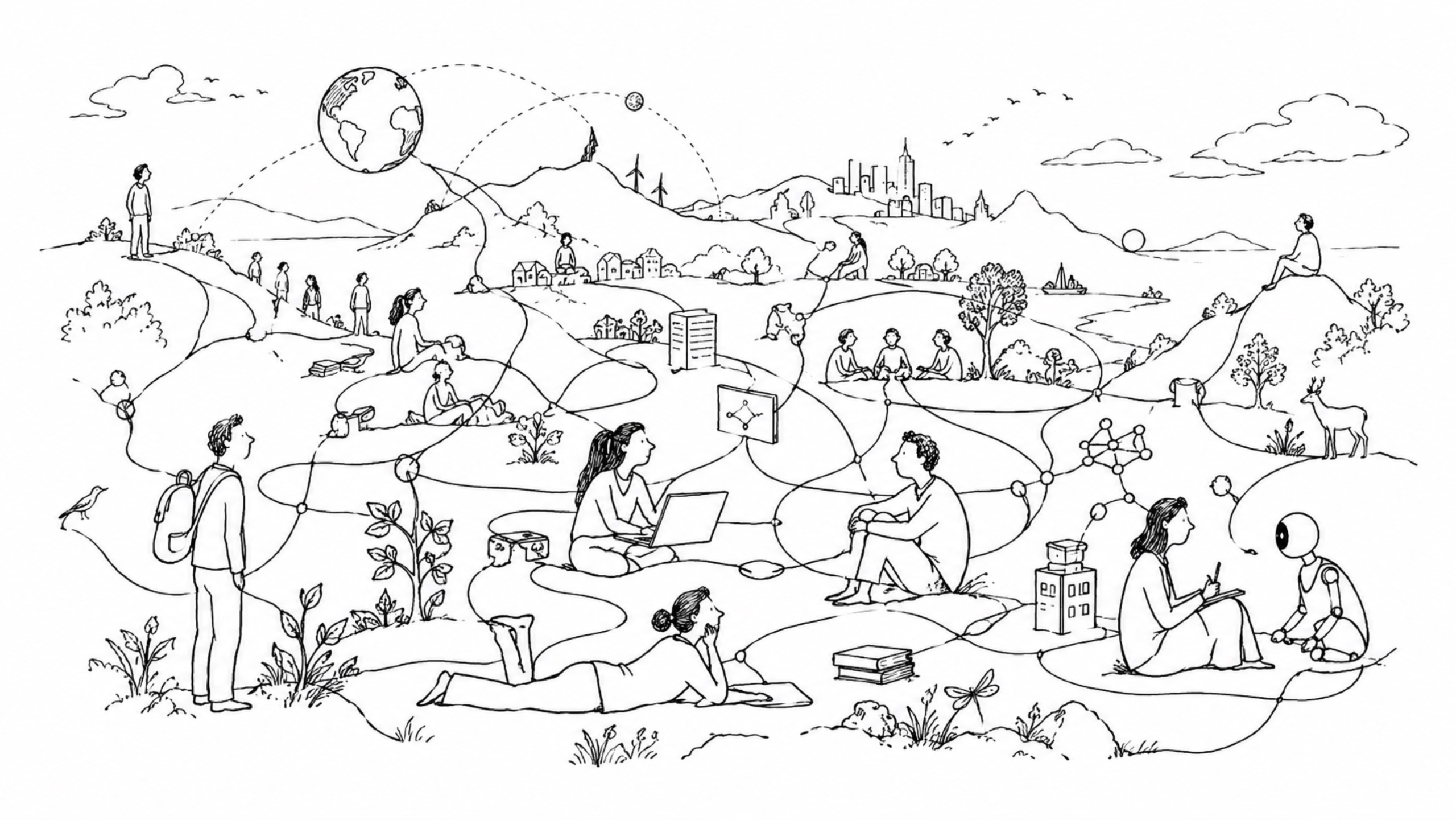
This presentation, Entangled Cognitions and AI: a Complexivist Perspective on AI and Learning, is an attempt to situate generative AI in the context of complexivist approaches to learning such as Connectivism, Rhizomatic Learning, Landscapes of Practice, Entanglement, Enactivism, and many other theoretical models that treat learning as a complex phenomenon.
The point is not to advocate for any particular model but to help understand how the granularity of our cognition coarsens in an age of AI and why, viewed from a perspective of extended and collective cognition that is common to complexivist accounts of learning, that this is not (necessarily) a bad thing at all. It does, however, demand more urgently than ever that we reframe the purpose, content, pedagogy, and expectations of our educational systems, reimagining or re-remembering them not as mills for the production of learning outcomes but as learning hubs where we learn tacit, unquantifiable, but critical values, attitudes, and ways thinking in the company of others. Central to all that are our indivisible relationships with the technologies (including poetry and pedagogy) that we are parts of and that are parts of us and of which, prior to genAI, we were the exclusive creators, and our relationships with the others with whom and through whom we learn ways of being human.
Unusually, for me, it includes a bibliography.
