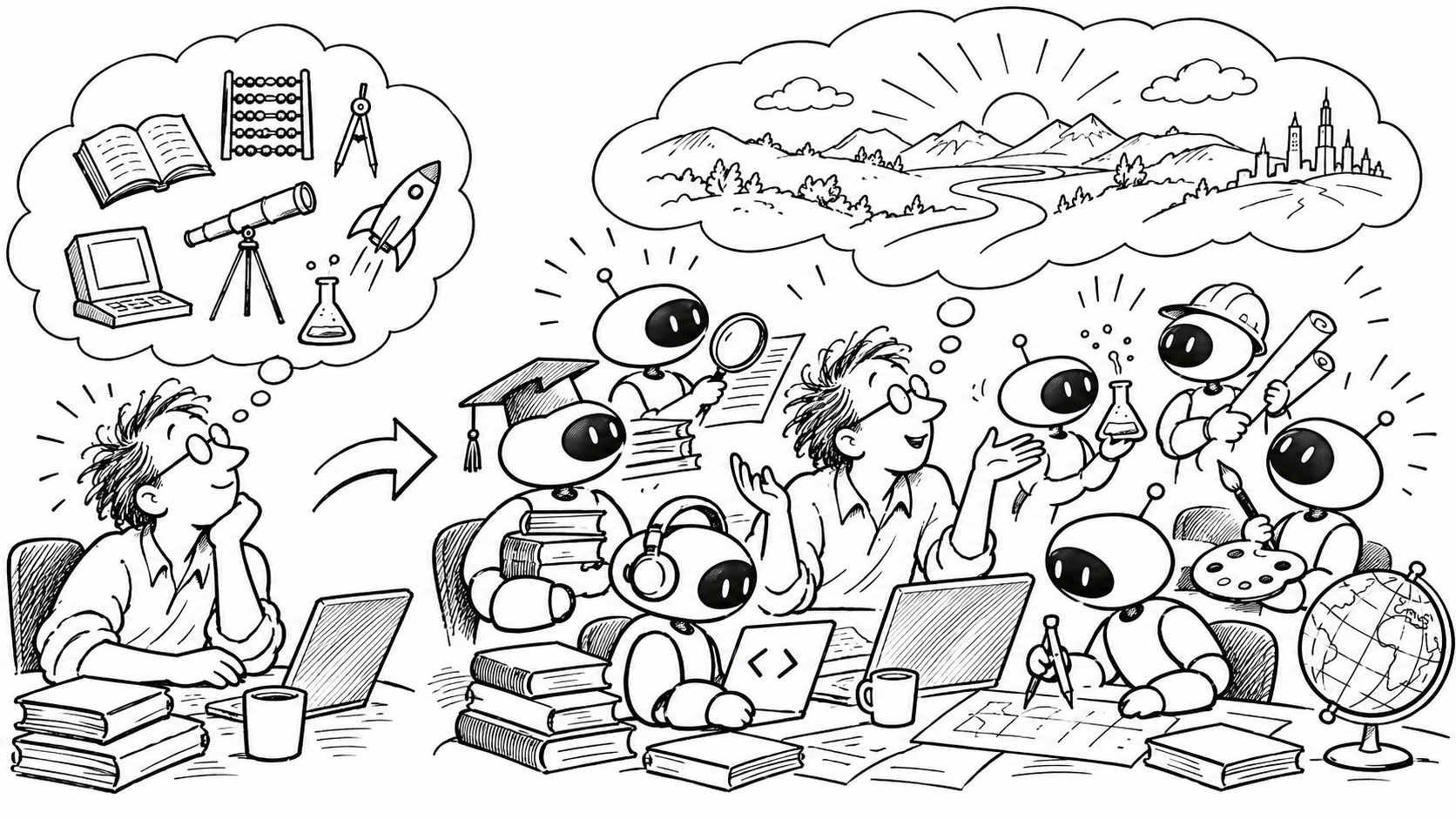
These are my slides, Towards genAI-native pedagogies, from the keynote I gave online at the Global AI Summit, 2026 this evening (technically tomorrow morning at the conference), hosted by Bennett University, Greater Noida, India.
The talk was about my latest thoughts on how and what to learn in a world with genAI in it: an answer to the question of whether and how education should change.
The first half mostly covered ground I have covered before: that genAIs are (or can be) wise because they channel and remix the collective wisdom of (many, many) humans, that the wisdom is in the words and symbols, not the machine, that they are not tools but cognitive Santa Claus machines, that there are great risks if we continue to teach how and what we have always taught (especially if we use genAIs to do it), that learning to be human through interaction with not-quite humans is a really bad idea, and that the tacit, relational, value-laden stuff – the ways of being, doing, and thinking – are what really matters.
The second half is the part with the native genAI pedagogies, starting with the observation that we should not be worrying about keeping humans in the loop: rather, we should be seeking ways of incorporating genAIs in our network. The gist of the next few slides is concerned with using AIs to do what they do best, and holding onto the relational, meaning-making, caring, sense-making, goal-setting, connecting aspects of education for ourselves. The last few slides are about the rest: finding or making the right kind of friction (the challenge), embracing the power of the collective intelligence genAIs offer to do more than we could do before, using them to support intrinsic motivation, designing your bots carefully, and (above all) focusing on relationships: between self and others, self and culture, self and society, self and tools, self and the environment, and so on.
My ultimate answer to the question of whether education should change was “not exactly”. I mean, obviously it should, a lot, but the change is more one of emphasis than of kind. We have always learned the tacit for free because humans have been its only source but now we really have to think about it and, where possible, make it explicit or, if not, create conditions where it will be learned from and with other humans. That’s not new, but it needs plenty more thought than before, and does not fit with the ever-more managerialist outcomes-driven machine that education is rapidly becoming.
We have also always come at the problem with the assumption that it would not be economical for everyone to learn different things at different paces and different times. This is how we wind up with educational systems in which we coerce people to learn, which is ridiculous in the extreme, and the assumption is simply not true any more. We no longer need to coerce people to learn the same things in lock-step with one another: we can actually do the right things to support intrinsic motivation. Autonomy is not just something we can allow but, realistically, with genAI, it is something we cannot (and absolutely should not try to) prevent. The right level of challenge is also possible, because these machines can be wise tutors and have the patience to target teaching at the right level, without the threat of failure, learning about their students in literally superhuman ways. And we can drop the notion of failure altogether: it’s just stuff that hasn’t been learned yet. We can use the time saved to build on the relatedness that is the one thing genAI cannot do better than (most of) us, notwithstanding the disturbing tendency for some people to form “relationships” with these machines. And we can rely on the machines to harvest outcomes as they observe behaviour, not measure conformity with a fixed set of hoops students must jump through. Basically, we can solve the huge tension at the centre of our educational systems between credentials and learning, if we set our minds to it and pick our battles wisely.
To do this, we really need to stop teaching the same old stuff. That is thinking small, local, and unimaginatively. Big, wonderful, amazing, divergent, creative, meaningful activities are possible, even for beginners, as long as we create or support the right challenges, the right friction. And, I guess, that does sound a lot like a transformation when compared with most education today but, really, it is just doing at scale what we could only do in very small groups or dyads before, and doing it better because we now have a direct conduit for the collective wisdom of our species.
In my talk I deliberately ignored a whole boatload of really bad stuff – the environmental impact, the complexities of ownership, the massive influence of a few, the significance of the harnesses and training regimes in making genAIs not quite our collective intelligence but highly skewed and partisan distortions of it, the inequities, the hallucinations, the economic upheavals, and so on and so on. These (apart from the hallucinations but that’s not really a problem) are more issues with capitalism than with AI, amplifying and highlighting its manifold failings in new and interesting ways. They are soluble, given time and the will, and we do need to have the will to solve them, and maybe use our time more wisely. However, in the grand scheme of things, over the long term, if the trillionaires and crackpot detritus formed by delegating our critical faculties to social media influencers don’t wreck it all beyond repair, and above all as long as educators don’t carry on doing what we have been doing for the last 1000 years, the future could be very bright. It might be a tall order but we do have to try.
Afterword
I’ve been using this style of illustration for my last few talks, incidentally, generated by ChatGPT. Should you want something similar, I did it with the prompt “I would like the images to be reminiscent of the drawings of James Thurber (though more serious), with a simple line drawn style on a white background”. I did have to constantly remind it to return to the Thurberesque style because it started getting a bit too creative but (at least as far as the style was concerned) that’s all it needed. Many of the images were generated not by saying what I wanted it to draw but by explaining the concepts I wanted it to illustrate; typically a paragraph or two of text. In retrospect these should have been my presenter notes. Its interpretations were mostly pretty good, though I often had to provide more precise instructions about modifications once it had visualized the main idea.
This strikes me now as being nicely self-referential. One of my bigger messages was that the real power of these things lies not their (really our) depth of knowledge, though that can be very impressive indeed: it’s the breadth, and the connections they can consequently make between things no single human could hope to connect. Though his interpretation would undoubtedly have been much funnier, richer, and deeper, even Thurber himself might have struggled with a prompt like “In the same style I want to represent the concept that education is a collective and holistic process: that the buildings, rooms, furniture, labs, textbooks, libraries, whiteboards, desks, etc and above all the people around you all contribute materially to teaching everyone involved in the process. I want to explain how genAI has changed this because genAI is not just part of that collective teacher but it relies on, refines, remixes, and channels the collected collective knowledge of a good portion of the human race. Thus, it is not just part of the collective teacher but a focused reflection of it. I’d like the dynamic nature of this to come through – that there are good, beneficial feedback loops throughout but, especially, that the genAI is fed by and then feeds the collective.”
And Thurber would have taken a lot longer to do it.
