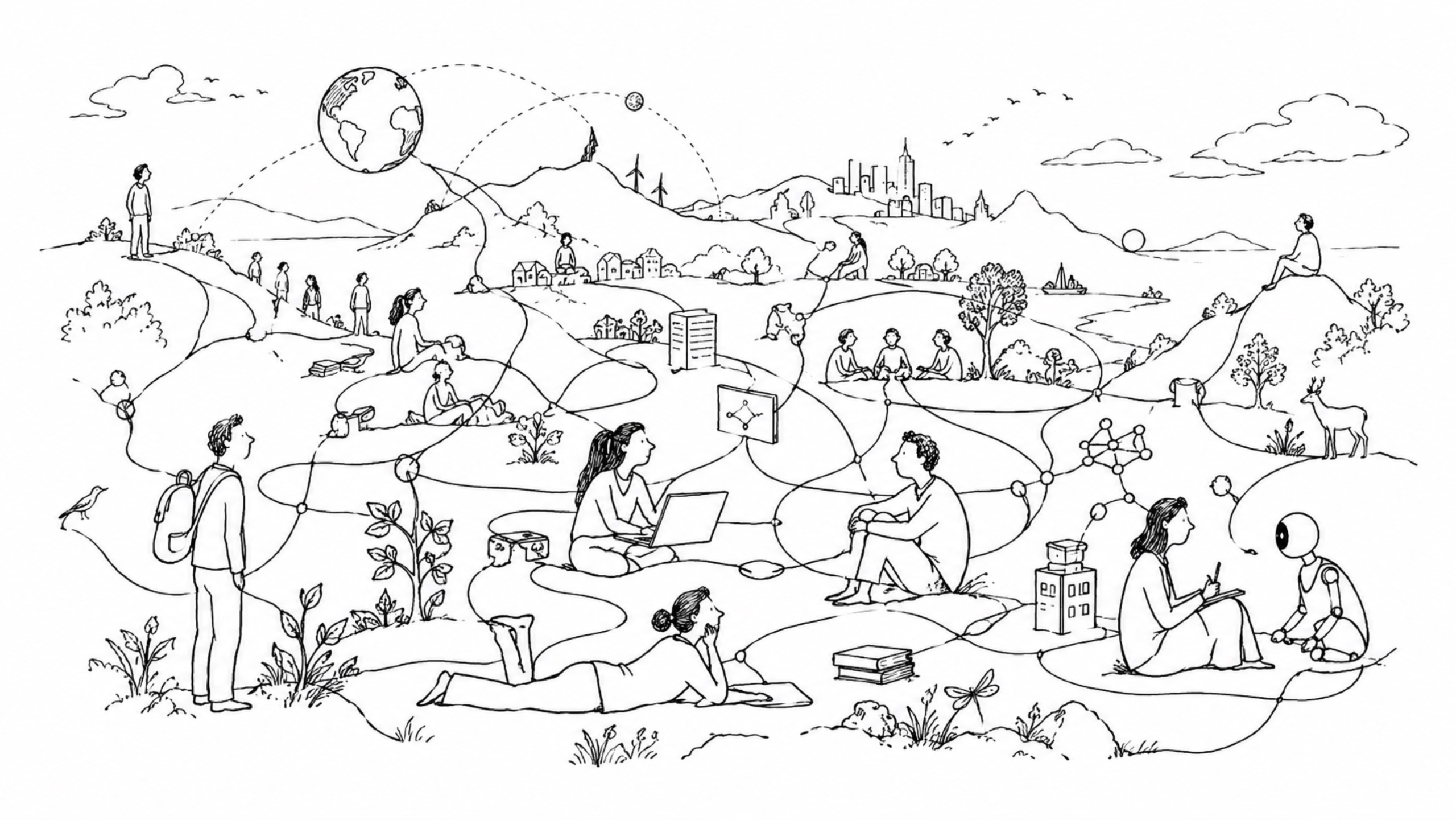
What does it mean for higher education to work?
The problem with claiming (as I sometimes do) that higher education is broken and needs to be transformed is that it begs the question of what it means for higher education to work, and that depends what you think it is for.
From the name you’d expect that higher education might be for …well… education, assuming that to be concerned with learning and teaching, but it outgrew that single purpose a very long time ago. Yes, learning & teaching still looms large, but credentialing is at least as significant (often more so) and, at least for some, so are research or various forms of service. But, depending on your perspective and context, a university or college might also or alternatively be thought of quite differently as, for example:
- a driver of peace or prosperity in a society;
- a creator of knowledge in the world;
- a support for local economies;
- training for industry;
- a market for contract cheating;
- a home for sports teams;
- a sharer and preserver of cultural artifacts;
- an incubator for the performing arts;
- a means to get a better job;
- a medical facility;
- a production line for professors;
- an enabler of social mobility;
- a profit-/surplus-making business;
- a political pawn;
- a selection filter for smart people;
- and so on, and on, and on.
You might reasonably object that you could take any one of these away apart from the teaching role and you would still be left with a recognizable educational institution and, indeed, some are possible only because of the teaching role. However, to some people, somewhere, some time, every one of those roles is the role that matters most, and might be a target for transformation. Like every instantiated technology, a university or college is an assembly. In fact it is a huge assembly. It is part of and contains countless other assemblies, and is thoroughly, deeply entangled with a host of other systems and subsystems on which it depends and that depend on it. Everyone within it or interacting with it perceives it from a different perspective, in different ways at different times, working together or independently as mutually affective coparticipants to do whatever it is that, from each of those different perspectives, it does. In many ways, as a whole, it thus resembles an ecosystem and, like an ecosystem, each individual part can be perceived as having a goal and a relationship with other parts, and with the whole, but the whole itself does not. I think this is probably a feature of institutions in general, and may be what distinguishes them most clearly from simple organizations and businesses.
So what?
As long as the distinct roles, from each individual’s perspective, do their jobs, this is not a problem. If you are interested in, say, in getting an education then you can largely ignore everything else an educational institution does and judge it solely by whether it teaches, notwithstanding the huge complexities of knowing what that even means, let alone with what proxies to measure it.
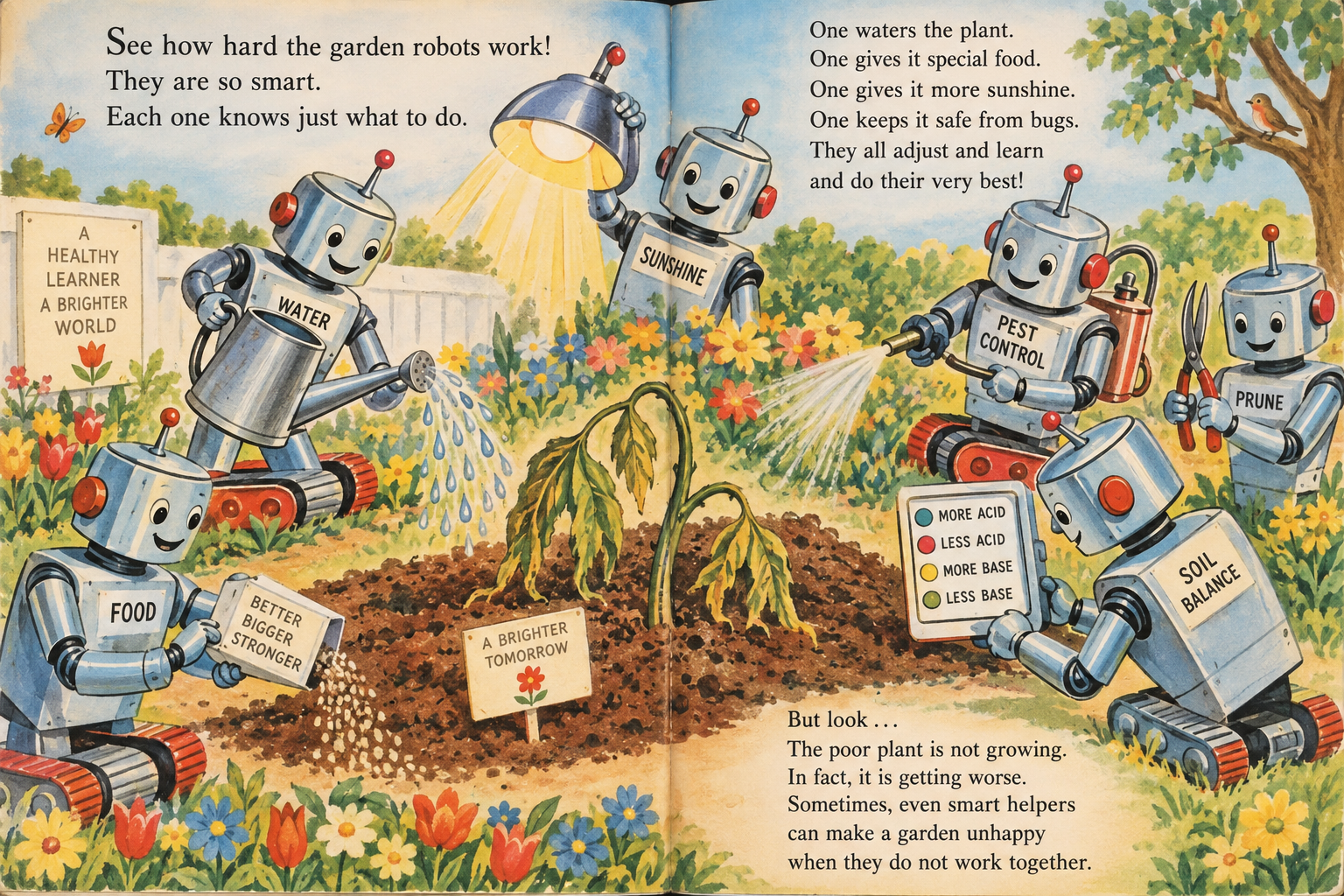
Unfortunately, a fair number of these roles deeply and negatively impact others. For me, by far the biggest problem is that the credentialing role is fundamentally at odds with the teaching role, due to the profound negative impact of extrinsic motivation on intrinsic motivation (I’ve written a lot about this, e.g. in these slides and in How Education Works so I won’t repeat the arguments again here). Combined with the side effects of trying to teach everyone the same thing at the same time, this results in the vast majority of our most cherished teaching and assessment methods being nothing more than ways of restoring or replacing the intrinsic motivation sucked out of students by how we teach and assess. Other big conflicts matter too, though. For instance, when patents or copyrights are at stake, the business role battles with the underlying goal of increasing knowledge in the world, turning non-rival knowledge into a rivalrous commodity; ditto for the insanity that is journal publishing, where the public pays us to provide our editorial and reviewing services for papers on research that they also pay for, then the journals sell the papers back to us or charge us for sharing them, making obscene profits for an increasingly trivial service; similarly, the research role, that should in principle exist in a virtuous circle with teaching, is too often in competition with it and, in many institutions, teaching loses; the filtering role that rewards most universities (not mine) for excluding as many students as possible is in direct conflict with a mission to bring higher forms of learning to as many people as possible, and undermines the incentive to teach well because those carefully selected students will learn pretty well regardless of how well they are taught. There are countless other examples like this: public vs private good, excellence vs equity, local vs global responsibilities, supporting student diversity vs economic stability, and so on. Fixing one role invariably impacts others, usually negatively. These are structural issues that will persist as long as higher education continues to play those roles. The solutions to the problems in one role are the problems that other roles have to solve, and (to a large extent) they must be.
At a micro scale the problem is even more ubiquitous. Everyone is solving problems in their own local sphere, creating problems for others in their own local spheres, whose solutions cause problems for others, and so it goes around and comes around. Every time we create a solution to one problem we give rise to other problems elsewhere. To give a few trivial and commonplace examples of issues I am trying to deal with right now:
- I recently learned of two courses that could not be launched because tutors for the single course that they replace would have to be rehired and lose benefits gained for long service. In terms of priorities and primary roles, this implies that offering stable employment to staff matters more than teaching. That’s not the intent of any particular individual involved in the process but it’s how the system works, thanks to union agreements that solved different problems a long time ago.
- For nearly 50 years now, our undergraduate students have had 6 months to complete a course, unless they are grant-funded (an important minority), in which case they only get 4 months because funding bodies assume universities always teach in semesters of a standardized length and demand results within that timeframe. And so we are in the process of making all contracts 4 months, knowing full well that students will be more pressured, cheating will increase, and pass rates will go down, but at least it will be fairer.
- When we commit structures to code they are supposed to model the system but, having done so, they normally dictate it. For instance, my need for all of our faculty to be able to see the teaching sites of all of our courses (a critical part of my strategy to improve our teaching) is under threat due to the cascading roles used to determine who can do what that are baked into the implementation of our LMS and that make it difficult and long-winded for our editors to edit our courses, because the roles have to be modified each time they use its impersonation function that is necessary for viewing courses as they will be experienced. The obvious solution is to fix those roles, not remove access for those who need it, but the editors lack such rights, and those who have them support other faculties with different and conflicting needs.
- We have recently shifted to a centralized front-line support system, explicitly to deal with common difficulties students have in navigating and using our administrative systems and websites. The more obvious solution would be to make those systems work better in the first place. Instead, we employ vast numbers of people whose job it is to patch over gaps, errors, and poor design decisions made elsewhere. This reduces the pressure to fix the systems, so the need persists, except that now we have a whole load of people with jobs that would be in jeopardy if we fix them. We employ many people whose job is to fix problems caused by issues with how others do theirs: people dedicated to exam cheating, say, or accommodating disabilities, or the aforementioned editors. There’s a fine and indistinct line between dividing a workload so that people with the right expertise do the right things, and creating a workload because people with the wrong expertise have done the wrong things.
I could easily write pages of similar examples and, if you work for a university or college, I’m sure you could too: the specific problems may be peculiar to Athabasca University, but the underlying dynamics are ubiquitous in higher education and, for that matter, most large organizations. And I’m sure that you can think of ways to deal with any of them but that’s exactly the point: fixing them is what we all do, all the time, every day, on a grand scale, and educators have been doing so for nearly 1000 years so the number of fixes to fixes to fixes to fixes is vast. For almost any role or activity, no matter how small or how large, there is probably another role and set of activities on which it impinges, directly or otherwise.
The big problem is that, on the whole, we create counter-technologies to fix the worst of the problems and that’s a policy of despair, every counter-technology creating new problems for further counter-technologies to solve. In fact, a large part of the reason for all those many roles is precisely because counter-technologies were created to solve what probably seemed like pressing problems and, in an inevitable Faustian bargain, created the problems we now need to address. Every one of these counter-technologies increases the robustness of the whole, increasing the interdependencies, making the patterns more and more indelible so, even if we do occasionally come up with something truly different, the overall system holds together as a massive web of mutually interdependent pieces more strongly than ever.
The more things change…
For all the many structural problems, it would be a synecdochic fallacy of mistaking the part for the whole to describe higher education as broken. Sure, thanks to all those competing roles (especially credentialing) it is not particularly great at education (at least), so transformation is devoutly to be wished for but, by the most basic and essential criterion of all – survival – it is rampantly successful. In fact, it is exactly those competing and complementary roles that have sustained it because a diverse ecosystem is a resilient ecosystem. The webs of dependencies are mutually sustaining even, to a well-evolved point, when one is antagonistic to the other.
For nearly a millennium the university and its brethren have not only survived but have now spread to almost every populated region of the world, and they continue to expand. Within my lifetime, in my country of birth, enrolments in higher education have risen from around 5% of the population to around 50%. To achieve such success, it has had to evolve: the invention of written exams, say, in the 18th Century, Humboldtian models that justified and embedded research, the adoption of flexible curricula, or the admittance of women in the 19th Century, were all huge changes. It has lost the trivium and quadrivium along the way, and diversified enormously in the range of subjects taught. The technological systems are way more advanced and varied than they were. There are regional variations, and a few speciated niches (colleges, open universities, distance education, etc). Administratively, a lot has changed, from recruitment and enrolment to the roles of professional bodies, industry, and governments. It is constantly evolving, for sure.
But.
The main technological features that universities acquired in the first century of their existence are still fully present, in virtually unaltered form. Courses, classes, terms/semesters, professors, credentials, methods of teaching, organizational structures, methods of assessment, and plenty more are visibly the same species as their mediaeval forebears, and remain the central motifs of virtually all formal higher education. We may use a few more polyesters and zippers, and the gowns now come in women’s sizes but, at least once a year, many of us even dress the same, a behaviour shared with only a few other institutions like (in some countries) the legal profession or the church. On the subject of which, most universities continue to have roles like dean, chancellor, rector, provost, registrar, bursar and even the odd beadle (what even is that?) that not only reveal their ecclesiastic origins but also how little the basic entities in the system have since evolved.
If the purpose of higher education were simply to educate then we would expect it to work a lot better and to see a whole load more variation in how it is done, especially given the wide range of technologies that can now be used to overcome the problems caused by those features, but we don’t. It’s not just the purpose that survives: it’s the form. We can radically alter a great many processes but changing at least one or two of the central motifs themselves – which, to me, is what “transformation” must entail – is hardly never even on the table.
Adaptation, not transformation
If the institution had a clear overriding goal then we could re-engineer it to work differently, but this is not an engineering problem: it’s an evolutionary problem. We build with what we have on what we have, a process of tinkering or bricolage that is anything but engineered. It is, though, not natural but technological evolution. In natural ecosystems massive disruption can occur when populations become isolated, or when the environment radically changes. Technological evolution emerges through recombination and assembly of parts, not genes, and the technologies of higher education have evolved to be globally connected and massively intertwingled with nearly every other part of nearly every society, making isolation virtually impossible. In nature, ecosystems can be disrupted by invasive species, parasites, etc, but our educational systems – technologies one and all – have evolved to be great at absorbing stuff rather than competing with it, so even that path is fraught. Even something as apparently disruptive as generative AI, which is impacting almost every aspect of the system and all the systems with which it interacts, is currently causing reinforcement of objectives-driven models of teaching, (at least in Western countries) cultural individualism, and highly traditionalist solutions to fears of cheating like written and oral exams at least as much as it is inspiring change.
For those of us who care about the education role, there are plenty of ways we could actually transform it if we had the power to make the necessary changes. Decoupling learning and assessment would be a good start. Not just separating teaching and tests: that would just result in teaching to the test, as we see now. The decoupling would have to be asymmetrical, so the assessed tasks would demand synthesis of many taught things. Or we could get rid of classes and courses: to a large extent, this is what (despite the name) many Connectivist MOOCs have attempted to do, and it is also the pattern behind things like the Kahn Academy or Connect North’s AI Tutor Pro, not to mention traditional PhDs (at least in some countries), apprenticeship models of learning, most instructional videos on sites like YouTube, or Stack Exchange or Quora, and the bulk of student projects (like MOOCs, labelled as courses but lacking most if not all of their traditional trappings). Or we could keep courses but drop the schedules and time limits. If nothing else, imagining how things might work if we messed with those central motifs is a good way to stimulate creative use of what we have. If done at scale, such things could make a huge impact on our educational systems.
But they probably won’t.
The problem always comes back to the fact that, though (collectively) we could change the fitness landscape itself, making survival dependent on whatever we think matters most, we are unlikely to agree what does matter most. For some, better higher education would be measured in credentials, or explicit learning outcomes, or better fits with industry needs. Others would like it to advance their personal careers or status, or to do research without a profit motive. For me, improvements would be in far harder-to-measure aspects like building safer, kinder, smarter, more creative societies. Unfortunately (for me and others who feel that way), thanks to pace layering, the ones who could shape the fitness landscape the most are governments, and they are the least likely to do so. Governments tend to prefer things that are easier to measure, quicker to show results, that are most likely to keep voters voting for them and sponsors (especially from industry) sponsoring them. Increasingly, institutional mandates are measured by industry-impact, which does erode some traditional aspects of higher education but that reinforces the big ones, like the measurable, assessed, outcome-driven course, with its classes, its schedules, its semesters, its textbooks, its assessments, its teachers, and so on. It doesn’t have to, in principle but, in practice, those are not the things we adapt. If radical transformation ever does occur it will therefore most likely be the result of something so disruptive that the loss of higher education would be a minor concern: devastation caused by climate change, or nuclear war, or being hit by a large asteroid, for instance. And, to be honest, I’m not even sure that would be enough.
The limited chances of success should not discourage us from tinkering, all the time, whenever we can. Evolution must happen because the world that higher education inhabits evolves so, if this is the system we are stuck with, we should make it do what we want it to do as best we can. There are usually ways to reduce dependencies, techniques to decouple antagonistic roles, strategies of simplification, approaches to parcellating the landscape (skunkworks, etc), and values-based principles for prioritizing activities that can make it more likely that the changes will be successful and persistent. However, if we have learned anything from biological studies over the past many decades, it is that you shouldn’t mess with an ecosystem. Whatever we do will put it out of balance, and self-organizing dynamics will ensure that either the balance will be restored, or that it spirals out of control and breaks altogether. Either way, it will never be exactly what we planned and, on average, it will tend to eventually keep things much the same as they are while making most of it worse while it restabilizes itself.
Knowing that, though, can be useful. If every change will result in changes elsewhere, it is not enough to monitor the direct impact of an intervention: rather, we need to figure out ways of harvesting the outcomes across the system and/or, as best we are able, to model them in advance. No one has access to more than a fraction of the information needed, not least because a because a significant amount of it is tacit, embedded in the culture and practices of people and communities within the system. However, we can try to intentionally capture it, to tell stories, to share experiences and understandings across all those many niches. We can do what we can to make the invisible visible. We can talk. And we have technologies to help, inasmuch as we can train AIs to know our stories and ask them about the impacts of things we do, and point out impacts that would be difficult if not impossible for any person to do. And that, I think, is the only viable path we have. The problems we generally have to deal with are a direct result of local thinking: solutions in one space that cause problems in another. The less locally we think about such things, the greater the chances that we will avoid unwanted impacts elsewhere or, equally good, that we will cause wanted impacts. To achieve that demands openness and dialogue, channels through which we can share and communicate, and some way of compressing, parsing, and relaying all that so that sharing and communication is not the only thing we ever do. This is not an impossibly tall order but it certainly isn’t easy.