Towards genAI-native pedagogies: slides from my keynote at the Global AI Summit 2026, India

These are my slides, Towards genAI-native pedagogies, from the keynote I gave online at the Global AI Summit, 2026 this evening (technically tomorrow morning at the conference), hosted by Bennett University, Greater Noida, India.

The talk was about my latest thoughts on how and what to learn in a world with genAI in it: an answer to the question of whether and how education should change.

The first half mostly covered ground I have covered before: that genAIs are (or can be) wise because they channel and remix the collective wisdom of (many, many) humans, that the wisdom is in the words and symbols, not the machine, that they are not tools but cognitive Santa Claus machines, that there are great risks if we continue to teach how and what we have always taught (especially if we use genAIs to do it), that learning to be human through interaction with not-quite humans is a really bad idea, and that the tacit, relational, value-laden stuff – the ways of being, doing, and thinking – are what really matters.

The second half is the part with the native genAI pedagogies, starting with the observation that we should not be worrying about keeping humans in the loop: rather, we should be seeking ways of incorporating genAIs in our network. The gist of the next few slides is concerned with using AIs to do what they do best, and holding onto the relational, meaning-making, caring, sense-making, goal-setting, connecting aspects of education for ourselves. The last few slides are about the rest: finding or making the right kind of friction (the challenge), embracing the power of the collective intelligence genAIs offer to do more than we could do before, using them to support intrinsic motivation, designing your bots carefully, and (above all) focusing on relationships: between self and others, self and culture, self and society, self and tools, self and the environment, and so on.

My ultimate answer to the question of whether education should change was “not exactly”. I mean, obviously it should, a lot, but the change is more one of emphasis than of kind. We have always learned the tacit for free because humans have been its only source but now we really have to think about it and, where possible, make it explicit or, if not, create conditions where it will be learned from and with other humans. That’s not new, but it needs plenty more thought than before, and does not fit with the ever-more managerialist outcomes-driven machine that education is rapidly becoming.

We have also always come at the problem with the assumption that it would not be economical for everyone to learn different things at different paces and different times. This is how we wind up with educational systems in which we coerce people to learn, which is ridiculous in the extreme, and the assumption is simply not true any more. We no longer need to coerce people to learn the same things in lock-step with one another: we can actually do the right things to support intrinsic motivation. Autonomy is not just something we can allow but, realistically, with genAI, it is something we cannot (and absolutely should not try to) prevent. The right level of challenge is also possible, because these machines can be wise tutors and have the patience to target teaching at the right level, without the threat of failure, learning about their students in literally superhuman ways. And we can drop the notion of failure altogether: it’s just stuff that hasn’t been learned yet. We can use the time saved to build on the relatedness that is the one thing genAI cannot do better than (most of) us, notwithstanding the disturbing tendency for some people to form “relationships” with these machines. And we can rely on the machines to harvest outcomes as they observe behaviour, not measure conformity with a fixed set of hoops students must jump through. Basically, we can solve the huge tension at the centre of our educational systems between credentials and learning, if we set our minds to it and pick our battles wisely.

To do this, we really need to stop teaching the same old stuff. That is thinking small, local, and unimaginatively. Big, wonderful, amazing, divergent, creative, meaningful activities are possible, even for beginners, as long as we create or support the right challenges, the right friction. And, I guess, that does sound a lot like a transformation when compared with most education today but, really, it is just doing at scale what we could only do in very small groups or dyads before, and doing it better because we now have a direct conduit for the collective wisdom of our species.

In my talk I deliberately ignored a whole boatload of really bad stuff – the environmental impact, the complexities of ownership, the massive influence of a few, the significance of the harnesses and training regimes in making genAIs not quite our collective intelligence but highly skewed and partisan distortions of it, the inequities, the hallucinations, the economic upheavals, and so on and so on. These (apart from the hallucinations but that’s not really a problem) are more issues with capitalism than with AI, amplifying and highlighting its manifold failings in new and interesting ways. They are soluble, given time and the will, and we do need to have the will to solve them, and maybe use our time more wisely. However, in the grand scheme of things, over the long term, if the trillionaires and crackpot detritus formed by delegating our critical faculties to social media influencers don’t wreck it all beyond repair, and above all as long as educators don’t carry on doing what we have been doing for the last 1000 years, the future could be very bright. It might be a tall order but we do have to try.


Afterword

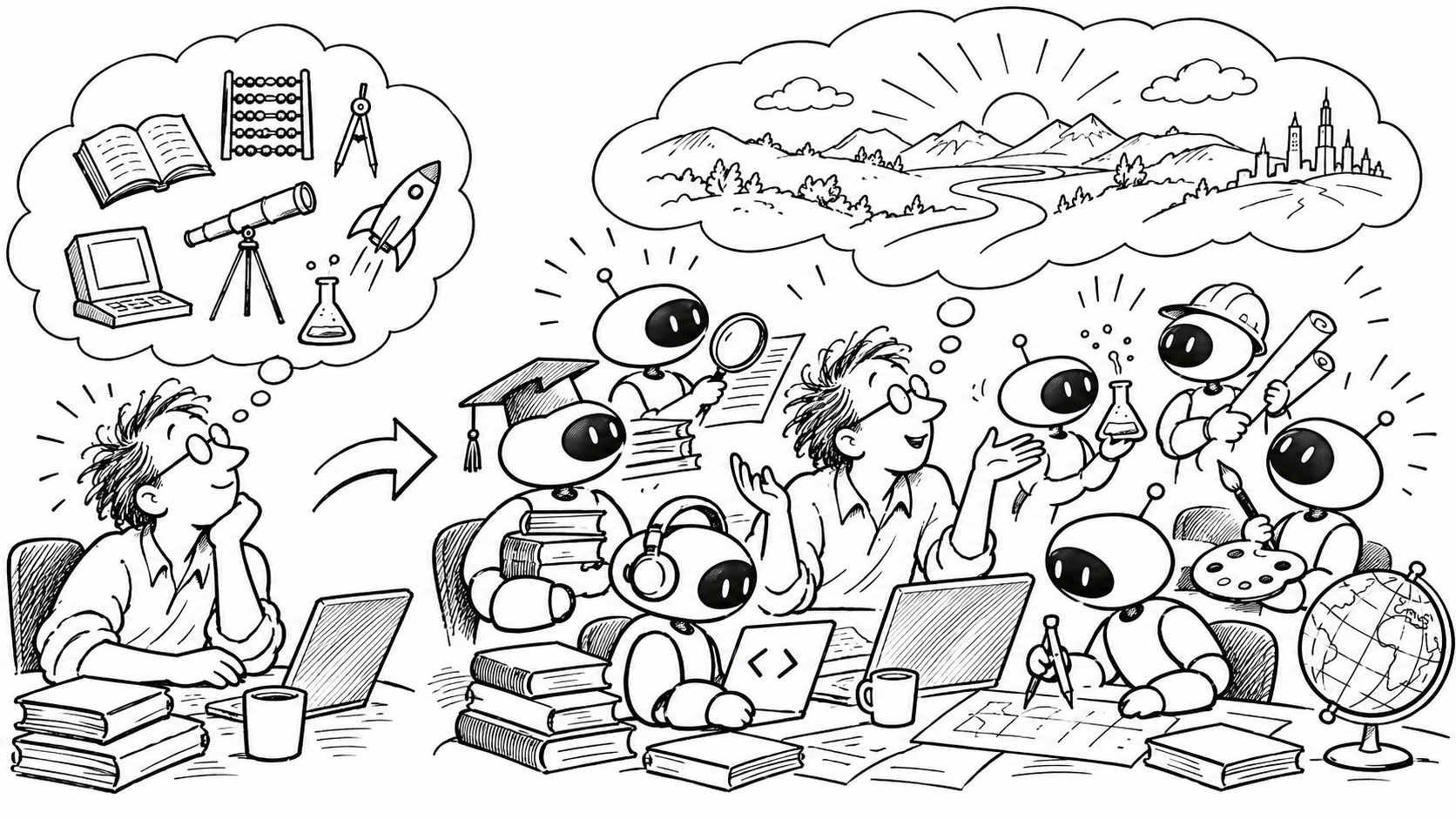
I’ve been using this style of illustration for my last few talks, incidentally, generated by ChatGPT. Should you want something similar, I did it with the prompt “I would like the images to be reminiscent of the drawings of James Thurber (though more serious), with a simple line drawn style on a white background”. I did have to constantly remind it to return to the Thurberesque style because it started getting a bit too creative but (at least as far as the style was concerned) that’s all it needed. Many of the images were generated not by saying what I wanted it to draw but by explaining the concepts I wanted it to illustrate; typically a paragraph or two of text. In retrospect these should have been my presenter notes. Its interpretations were mostly pretty good, though I often had to provide more precise instructions about modifications once it had visualized the main idea.

This strikes me now as being nicely self-referential. One of my bigger messages was that the real power of these things lies not their (really our) depth of knowledge, though that can be very impressive indeed: it’s the breadth, and the connections they can consequently make between things no single human could hope to connect. Though his interpretation would undoubtedly have been much funnier, richer, and deeper, even Thurber himself might have struggled with a prompt like “In the same style I want to represent the concept that education is a collective and holistic process: that the buildings, rooms, furniture, labs, textbooks, libraries, whiteboards, desks, etc and above all the people around you all contribute materially to teaching everyone involved in the process. I want to explain how genAI has changed this because genAI is not just part of that collective teacher but it relies on, refines, remixes, and channels the collected collective knowledge of a good portion of the human race. Thus, it is not just part of the collective teacher but a focused reflection of it. I’d like the dynamic nature of this to come through – that there are good, beneficial feedback loops throughout but, especially, that the genAI is fed by and then feeds the collective.”

And Thurber would have taken a lot longer to do it. 

Edison’s Infinite Workshop: Innovation and education in the age of Cognitive Santa Claus Machines (slides from my keynote for IFERP’s EdInnovate 2026)

Nek Chand's Rock Garden, illustrating the power of bricolage as a creative process
Statues in Nek Chand’s Rock Garden (photo by the author)

I’ve just finished giving a brief keynote for IFERP’s 3rd EdInnovate conference in Tokyo (sadly, because I love Tokyo in the Spring,  I was online). Here are the slides. The conference was great: they put all of the keynotes and invited talks on a single day, with a very international and cross-disciplinary bunch of thought leaders (and me), and many of us were talking about very closely related themes, of rehumanizing and transforming education, from very different perspectives. Though most of it confirmed what I already know, I learned a lot.

The gist of my talk was that generative AI challenges us to transform both how we teach and what we teach. I have spoken quite a bit about the “how” in the past – essentially it is to double down on the tacit, the relational, and the social, to care about and to empower learners, to focus on what it means to be a human in whatever fields we are trying to teach. The stuff we should already have been doing.

The “what” is new. GenAIs are pretty good at creating stuff, and that’s a problem because it is very, very tempting to get them to think for us (hence cognitive Santa Claus machines: we delegate the thinking to them so that we don’t have to). We now have access to most human knowledge, at a (mostly) expert level, with little skill needed to elicit any of it. These things are like search engines that actually give us what we are searching for, in detail, and then do whatever it was that we were planning to do with the search results on our behalf. If our descendants are not to be less than us (and I really want more for my own grandchildren), we now have to figure out what to do with that. If the answer is to turn in an essay or perform an assignment that any AI could do at least as well, then the world will end with a whimper. Our jobs are to take that, problematize it, and use it to create more than any of us (human or machine) could have created alone. Luckily we already have a model for that: bricolage, or tinkering.

Bricolage has got a bad rap in the past, often compared unfavourably with engineering (notably by Levi Strauss, who defined it and saw it as primitive) but, as Papert and Turkle wrote many years ago, it is a very legitimate way of engaging with the concrete, a highly creative activity in its own right, and it can be a very powerful approach to design. The photo at the top of this post shows just a handful of the thousands of stunning artworks created by Nek Chand and his team, all of it built from the waste products of the industrial city of Chandigarh – pieces of wire, chunks of porcelain, sacks of concrete, and other found objects. I have visited twice and cried at the beauty of it both times.

I have written of bricolage before, e.g. here and here (nicely reported on and more clearly expressed by Stefanie Panke), as a means of researching things that don’t (yet) exist, and I intend to write more. It seems to me, though, that this is one of the key skills that we should be developing for ourselves and for our students, not just for research but as a process and product of learning. It is the natural evolution of the steady progress from high-resolution to low-resolution cognition that has driven human progress for millennia. In the past we built on and with what other humans had already done: it is and has always been what makes us smart that we can, through technologies (including language and art), share parts of our cognition: we think with our creations. The more we create, the more we can create. Now we have machines that are themselves bricoleurs par excellence, capable of producing any parts or pieces we can imagine, at vast scale, and quite a few we cannot. This is different. If we take advantage of it, we can continue the technology-fuelled exponential growth that is a hallmark of our species (and, to be perfectly clear, art, writing, poetry, architecture, music, and all the humanities are among the most significant of those technologies). If we don’t, we face not just the model collapse of genAIs but, ultimately, of our own cognition. This is not about replicating what we can already do. It’s about being able to do what we cannot yet imagine. This seems like a good mission for education to me.

Generative vs Degenerative AI (my ICEEL 2025 keynote slides)

AI Santa fighting KrampusI gave my second keynote of the week last week (in person!) at the excellent ICEEL conference in Tokyo.  Here are the slides: Generative AI vs degenerative AI: steps towards the constructive transformation of education in the digital age. The conference theme was “AI-Powered Learning: Transforming Education in the Digital Age”,  so this is roughly what I talked about…

Transformation in (especially higher) education is quite difficult to achieve.  There is gradual evolution, for sure, and the occasional innovation, but the basic themes, motifs, and patterns – the stuff universities do and the ways they do it – have barely changed in nigh-on a millennium. A mediaeval professor or student would likely feel right at home in most modern institutions, now and then right down to the clothing. There are lots of path dependencies that have led to this, but a big part of the reason is down to the multiple subsystems that have evolved within education, and the vast number of supersystems in which education participates. Anything new has to thrive in an ecosystem along with countless other parts that have co-evolved together over the last thousand years. There aren’t a lot of new niches, the incumbents are very well established, and they are very deeply enmeshed.

There are several reasons that things may be different now that generative AI has joined the mix. Firstly, generative AIs are genuinely different – not tools but cognitive Santa Claus machines, a bit like appliances, a bit like partners, capable of becoming but not really the same as anything else we’ve ever created. Let’s call them metatools, manifestations of our collective intelligence and generators of it. One consequence of this is that they are really good at doing what humans can do, including teaching, and students are turning to them in droves because they already teach the explicit stuff (the measurable skills and knowledge we tend to assess, as opposed to the values, attitudes, motivational and socially connected stuff that we rarely even notice) better than most human teachers. Secondly, genAI has been highly disruptive to traditional assessment approaches: change (not necessarily positive change) must happen. Thirdly, our cognition itself is changed by this new kind of technology for better or worse, creating a hybrid intelligence we are only beginning to understand but that cannot be ignored for long without rendering education irrelevant. Finally genAI really is changing everything everywhere all at once: everyone needs to adapt to it, across the globe and at every scale, ecosystem-wide.

There are huge risks that it can (and plentiful evidence that it already does) reinforce the worst of the worst of education by simply replacing what we already do with something that hardens it further, that does the bad things more efficiently, and more pervasively, that revives obscene forms of assessment and archaic teaching practices, but without any of the saving graces and intricacies that make educational systems work despite their apparent dysfunctionality. This is the most likely outcome, sadly. If we follow this path, it ends in model collapse for not just LLMs but for human cognition. However, just perhaps, how we respond to it could change the way we teach in good if not excellent ways. It can do so as long as human teachers are able to focus on the tacit, the relational, the social, and the immeasurable aspects of what education does rather than the objectives-led, credential-driven, instrumentalist stuff that currently drives it and that genAI can replace very efficiently, reliably, and economically. In the past, the tacit came for free when we did the explicit thing because the explicit thing could not easily be achieved without it. When humans teach, no matter how terribly, they teach ways of being human. Now, if we want it to happen (and of course we do, because education is ultimately more about learning to be than learning to do), we need to pay considerably more deliberate attention to it.

The table below, copied from the slides, summarizes some of the ways we might productively divide the teaching role between humans and AIs:

Human Role (e.g.)

AI role (e.g.)

Relationships

Interacting, role modelling, expressing, reacting. Nurturing human relationships, discussion catalyzing/summarizing

Values

Establishing values through actions, discussion, and policy. Staying out of this as much as possible!

Information

Helping learners to see the personal relevance, meaning, and value of what they are learning. Caring. Helping learners to acquire the information. Providing the information.

Feedback

Discussing and planning, making salient, challenging. Caring. Analyzing objective strengths and weaknesses, helping with subgoals, offering support, explaining.

Credentialling

Responsibility, qualitative evaluation. Tracking progress, identifying unprespecified outcomes, discussion with human teachers.

Organizing

Goal setting, reacting, responding. Scheduling, adaptive delivery, supporting, reminding.

Ways of being

Modelling, responding, interacting, reflecting. Staying out of this as much as possible!

I don’t think this is a particularly tall order but it does demand a major shift in culture, process, design, and attitude.  Achieving that from scratch would be simple. Making it happen within existing institutions without breaking them is going to be hard, and the transition is going to be complex and painful. Failing to do so, though, doesn’t bear thinking of.

Abstract

In all of its nearly 1000-year history, university education has never truly been transformed. Rather, the institution has gradually evolved in incremental steps, each step building on but almost never eliminating the last. As a result, a mediaeval professor dropped into a modern university would still find plenty that was familiar, including courses, semesters, assessments, methods of teaching and perhaps, once or twice a year, scholars dressed like him. Even such hugely disruptive innovations as the printing press or the Internet have not transformed so much as reinforced and amplified what institutions have always done. What chance, then, does generative AI have of achieving transformation, and what would such transformation look like?
In this keynote I will discuss some of the ways that, perhaps, it really is different this time: for instance, that generative AIs are the first technologies ever invented that can themselves invent new technologies; that the unprecedented rate and breadth of adoption is sufficient to disrupt stabilizing structures at every scale; that their disruption to credentialing roles may push the system past a tipping point; and that, as cognitive Santa Claus machines, they are bringing sweeping changes to our individual and collective cognition, whether we like it or not, that education cannot help but accommodate. However, complex path dependencies make it at least as likely that AI will reinforce the existing patterns of higher education as disrupt them. Already, a surge in regressive throwbacks like oral and written exams is leading us to double down on what ought to be transformed while rendering vestigial the creative, relational and tacit aspects of our institutions that never should. Together, we will explore ways to avoid this fate and to bring about constructive transformation at every layer, from the individual learner to the institution itself.

Recording and slides from my ESET 2023 keynote: Artificial humanity and human artificiality

Here are the slides from my keynote at ESET23 in Taiwan (I was online, alas, not in Taipei!).

I will try to remember to update this post with a link to the recording, when it is available.

Here’s a recording of the actual keynote.

The themes of my talk will be familiar to anyone who follows my blog or who has read my recent paper on the subject. This is about applying the coparticipation theory from How Education Works to generative AI, raising concerns about the ways it mimics the soft technique of humans, and discussing how problematic that will be if the skills it replaces atrophy or are never learned in the first place, amongst other issues.

This is the abstract:

We are participants in, not just users of technologies. Sometimes we participate as orchestrators (for instance, when choosing words that we write) and sometimes as part of the orchestration (for instance, when spelling those words correctly). Usually, we play both roles.  When we automate aspects of technologies in which we are just parts of the orchestration, it frees us up to be able to orchestrate more, to do creative and problem-solving tasks, while our tools perform the hard, mechanical tasks better, more consistently, and faster than we could ourselves. Collectively and individually, we therefore become smarter. Generative AIs are the first of our technologies to successfully automate those soft, open-ended, creative cognitive tasks. If we lack sufficient time and/or knowledge to do what they do ourselves, they are like tireless, endlessly flexible personal assistants, expanding what we can do alone. If we cannot draw, or draw up a rental agreement, say, an AI will do it for us, so we may get on with other things. Teachers are therefore scrambling to use AIs to assist in their teaching as fast as students use AIs to assist with their assessments.

For achieving measurable learning outcomes, AIs are or will be effective teachers, opening up greater learning opportunities that are more personalized, at lower cost, in ways that are superior to average human teachers.  But human teachers, be they professionals, other students, or authors of websites, do more than help learners to achieve measurable outcomes. They model ways of thinking, ways of being, tacit knowledge, and values: things that make us human. Education is a preparation to participate in human cultures, not just a means of imparting economically valuable skills. What will happen as we increasingly learn those ways of being from a machine? If machines can replicate skills like drawing, reasoning, writing, and planning, will humans need to learn them at all? Are there aspects of those skills that must not atrophy, and what will happen to us at a global scale if we lose them? What parts of our cognition should we allow AIs to replace? What kinds of credentials, if any, will be needed? In this talk I will use the theory presented in my latest book, How Education Works: Teaching, Technology, and Technique to provide a framework for exploring why, how, and for what purpose our educational institutions exist, and what the future may hold for them.

Pre-conference background reading, including the book, articles, and blog posts on generative AI and education may be found linked from https://howeducationworks.ca