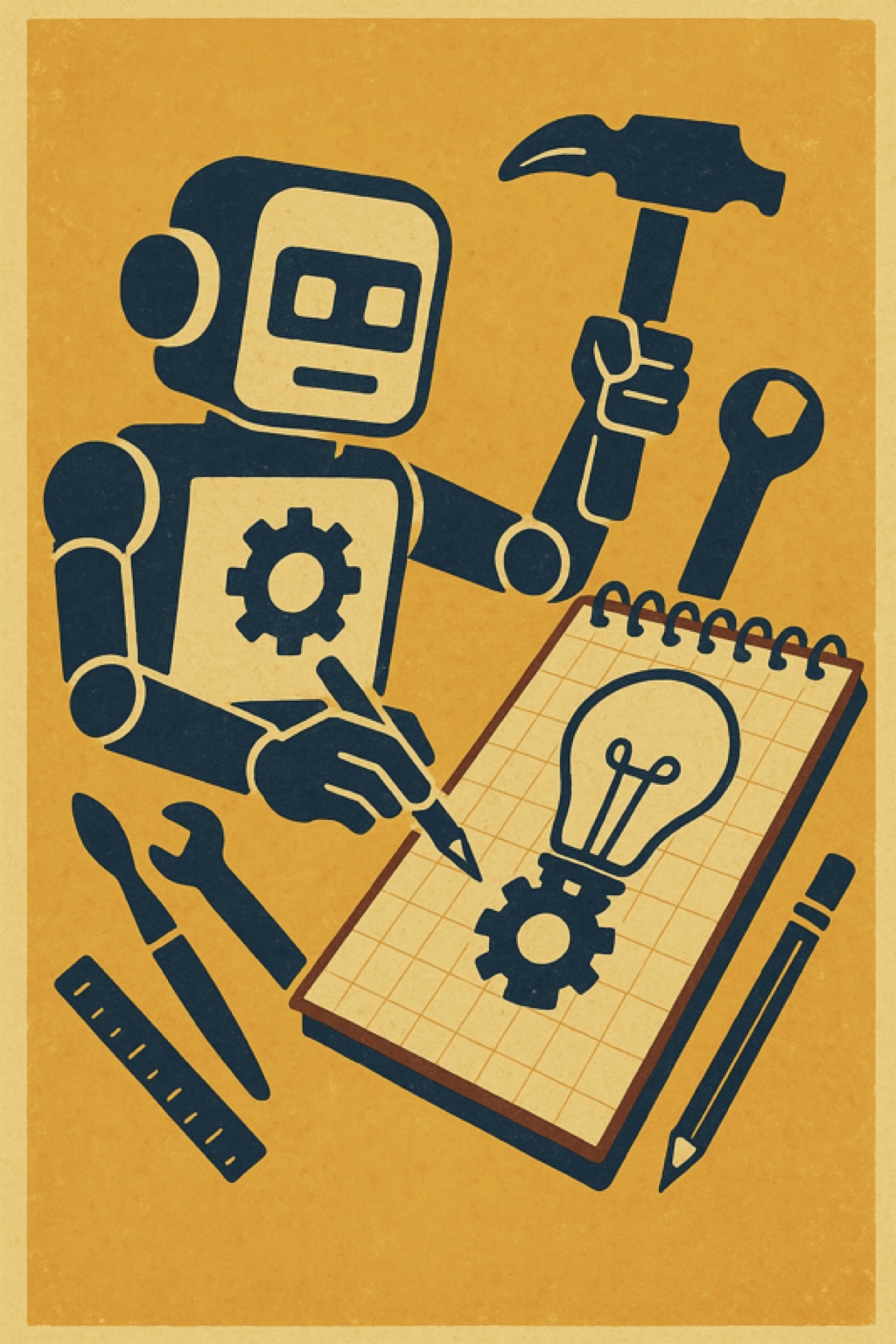
Paradigm shifts, bricoleers [sic], and other animals

Bricoleering, or adaptafacture illustratedBen Werdmuller is a serial innovator, edtech veteran, and deeply insightful commentator on the tech industry whose skills defy easy categorization. I like him a lot. In One size fits none: let communities build for themselves Ben tells us about how to build digital social systems that fit the needs of their communities, and it is well worth reading if you have any interest in social software.

The post starts with description of the reaction of developers when, in the Summer of 2007, at an Elgg-jam at my then-university in Brighton, Ben first introduced the newly refactored Elgg 1.0 framework. In its several pre-version-1 iterations, Elgg was not a development framework but a full-blown web application. It had blogs, wikis, file sharing, bookmarking, groups, and much more, all wrapped up in a robust social network system with smart discretionary access, extensible very easily through a simple-to-use plugin system. It was easy to use, rich in features, highly adaptable, and it might have been the most popular open source social networking system on the planet at that point. It was a bit hacked-together and not exactly an engineering masterpiece, but it worked really well.

What Ben announced that day stripped away virtually all of its existing functionality, leaving only a tiny core that could do almost nothing user-facing on its own apart from simple user management, the display of activities, and some basic admin tasks. I don’t think it was even possible to create a post and I have a feeling there were floppy disks around at the time onto which the whole thing could fit.  The idea was that it was up to developers to provide plugins that end-users could configure to create any kind of social system they wanted, with the core providing the API and data structures to support and greatly simplify their development. A few common tools like blogs, wikis, file sharing, and bookmarks were provided in a package of core plugins to help get things started, but all were (and are) optional. It was extremely elegant.

I believe that I was the person Ben refers to who, many years later (at another Elgg-jam, in San Francisco, as it happens), described his “big reveal” as a mind-blowing moment. Almost every hair on my body stood on end. I got it immediately because I had been thinking along very similar lines – there’s a chapter on such things in my first book, published earlier the same year – and had been, up until that point, intending to spend my newly-acquired national teaching fellowship money on building it. Instead I went with Elgg, which provided the framework on which the Landing and a few other sites (including the one at Brighton to which Ben refers) were built, and the money mostly went towards plugin development for it. 

In fact, in the form in which it first launched, Elgg 1.0 wasn’t exactly what I wanted. My vision was more distributed and centred around small services, loosely joined, rather than a single monolithic plugin-based server. The roadmap, though, that Ben described that day made exactly that possible, with plans for a robust and extensible range of services and standards for information interchange that, had they gained any traction, would have made a federated social system of almost any kind simple to create and evolve.

They didn’t gain that traction.

I think a big part of the reason might be that, with no backwards compatibility at all with the older version, and no good migration path for those already running Elgg, it lost almost all of the momentum and good will it had previously gained, and others had moved into the space in the interim that could provide an off-the-shelf experience that was at least as good as the replacement, without the need for further development. In particular, WordPress and Buddypress were already on the rise. Ben eventually moved on to do other things, Elgg gained a loyal and slowly growing following and became a foundation, but its focus shifted to being a development platform for building bespoke servers rather than a distributed social system.  The web services and neat ODD protocol never took off enough to be usable beyond some very limited use cases. However, the plugin-based architecture and tiny core was still a cool idea and building using small pieces for almost everything seemed to me to be a really good way to build a social system, so that’s what I and my teams did. It turns out to be much less cool when you want to maintain it, though, a fact that I was quite well aware of but failed to grasp in its full magnitude until it was too late.

Red Queen development

Running ever faster to stay in the same placeAs we built the Landing we soon ran into the painful flipsides of plugins, which include the fact that you can’t easily remove them once many people use them, the large number of dependencies they create, and the fact that they have to be maintained, at least every time the core gets updated. It is not helped by the fact that, I think for efficiency,  backwards compatibility is still rarely much of a consideration when Elgg gets an upgrade: though they will generally survive (with deprecation notices) for a version or two, many old plugins will simply break if they are not updated, often in subtle, difficult to debug ways. And part of the elegance of the design is also one of its greatest flaws: that, though you can design things in a more robust way, any plugin can fully override almost anything provided by any other simply by including a file of the same name and position in the directory hierarchy. This plays havoc with new versions, and makes plugins far more co-dependent than the very self-contained, well-encapsulated services I had been imagining. To make things worse, it does not scale at all well: Elgg’s object-over-relational data model is very elegant, but it is not very efficient when your site grows large, and every data-storing plugin adds to the problem.

At one point the Landing had 116 plugins (admittedly with a few turned off by default), about a third of which we built, a third of which were distributed with the core, and a third of which were community-developed. As well as our own plugins, we gradually had to take on more and more of the community-plugin development ourselves as original developers abandoned them, or face the wrath of those who needed them. Of the 90 or so that are left today, about half are our/my responsibility. On average, when things were going well and we had the funding for a full-time developer,  I reckon most plugins averaged about a person-week of design, development, and testing to upgrade, though the various dependencies and bottlenecks meant that it was rarely less than a month from start to finish before they arrived on the site. Meanwhile, the core was getting updates, sometimes more than once a year. With very little spare cash, especially after losing our full-time developer, there was no way that we could ever hope to keep up with the release cycles of the core and keep the number of plugins we had to maintain. We were stuck in a Red Queen Regime, running harder and harder to stay in the same place. Some call this a technological debt, but it’s just the price of ownership, and we couldn’t pay enough. 

It may be a blessing in disguise then, that, some 10 or 11 years ago,  the decision over whether to continue development was taken out of our hands by a CIO who refused us any resources to even test let alone to install anything, as a result of a grossly misguided “back to baseline” principle that ravaged many good systems during his tenure, even though we (then) had plenty of money to continue and offered to put it all into his budget. The Landing limped along regardless because it was embedded in many courses, research groups, centres, and so on, so it couldn’t simply be switched off, no off-the-shelf alternative came close to doing anything similar, and we built it to be robust (though never expecting it to still be around, almost unaltered, over a decade later) so it carried on working. With the help of less hostile but never exactly enthusiastic CIOs, we have limped along ever since, very slowly creeping up through the versions on a shoestring budget and odd moments of my own spare time, but we are very far behind the cutting edge.

And then came ChatGPT

LLMs – Claude in particular – can be great at coding, especially for small projects like plugins. I have been vibe coding for a few years now, and it has been incredibly useful in many aspects of my life. However,  even the best of them tend to struggle with Elgg plugins. I think it is because there is not enough Elgg code out in the wild, and there have been too many versions and too many approaches to development, so there’s not enough good quality training data. Since the first week of the launch of ChatGPT, I have been trying to get genAIs to help me with Elgg plugin upgrades and bug fixing but, though I have picked up some very helpful ideas in the midst of some very bad attempts at solutions and they have spotted a few bugs for me, not a single line of actual AI-generated code has ever made it onto the Landing. This is going to change. 

A few days before Ben wrote his post, on a hunch, after some frustrating attempts at getting Claude, ChatGPT and Gemini to upgrade an existing plugin that was too difficult for me to take on alone, I instead simply asked Claude to make me a new one, with specs I had extracted from the original (using ChatGPT and tweaking the output), but giving it no access to any of the original’s source code or program structure.

Apart from a couple of minor syntax problems that took hardly a minute to fix, it worked first time. It was considerably more polished than the original and, indeed, than almost all the plugins we had written ourselves or commissioned at costs of up to $10,000. It has no deprecated code at all – something that is not even true of plugins in the core for our current Elgg version – and it has all sorts of useful little configuration options that Claude extrapolated from the specs and that I would have been too lazy to bother with, but that make it way more adaptable than its predecessor. It even has a complete set of language files for both French and English – extremely rare in human-made plugins – and it would be trivial to ask it for other languages if we needed them.

I think this works because of the different way Claude approaches the problem compared with how it handles an existing plugin. When trying to fix a broken or obsolete plugin, the plugin itself plays a large influencing role, then Claude pulls on a ragtag bunch of existing plugins as examples, but the paucity and mixed quality of the training data means they are less than wonderful role models. Almost all of its prior attempts included code from a future version of Elgg, or an older one, or one that has never existed, and it quite often did things in a very non-Elgg way. In contrast, when building a new plugin from scratch, its strategy appears to be to read the entire core codebase and all of the official documentation, then to build the plugin to fit, with little or no reference to any existing plugins beyond those that come with the core distribution. When things go wrong, it goes straight to the definitive source of a function in the core, not to a muddle of existing solutions, and its context window (at least in the paid versions) is now large enough for it to contain much if not all of the whole thing, or at least for retrieval-augmented generation to deal with the correct pieces. The small core that was so useful to human developers turns out to be ideal for LLMs.

The key lesson to be drawn from this is that, if the architecture is sufficiently and cleanly modular (as Elgg’s is), then it may now be more effective to recreate components from scratch than to maintain the ones you have already written. If it continues to pan out as it has so far done, I’d say this is a potential game changer. As well as making development extremely agile, it even improves the security of the system because, though any one plugin may yet have flaws despite the apparently high quality of coding, it is not going to stick around for long enough for them to be exploited, and anyone who follows this approach is not going to have the same plugins as anyone else so it’s not worth anyone’s while to develop a specific hack for it. The next upgrade is almost ready so I am only going to use this approach sparingly for now but, when the time comes for the next major upgrade, this is how I intend to do most of it. I won’t let it near core plugins or still-maintained community plugins but, for all those we inherited or created, ChatGPT or Gemini will provide me with the spec. I’ll then run each spec through Claude, getting it to produce the complete plugin including unit tests. It will still take time, and I don’t expect it to work as well all the time, but much of that time will be spent by Claude, not me. At one fell swoop, this almost eliminates the technological debt.illustrating spec extraction and plugin creation using LLMS, in the style of Alice in Wonderland

This principle is not necessarily limited to elegantly engineered systems like Elgg. A night or two ago I went through my regular quandary about how to schedule ad hoc meetings for one of my courses. In the past I’ve used wikis, discussion forums, various free (but not quite right) poll-based schedulers like Doodle, and more. None were great, and the ones that worked best raised potential privacy concerns that I was not willing to grapple with. The length of time it takes to get a plugin to production made a Landing plugin a non-starter.  Then it struck me that my own personal website would be more private and controllable than any of those, and hosted on Canadian soil (unlike any of the rest) so I went in search of a plugin. WordPress is very inelegant, sprawling software, and plugin development is positively painful compared with Elgg, but the vast numbers of WP developers mean that, among the many tens of thousands of plugins, no matter what the task, at least one will do the job I want, or close enough for me to tweak so that it does. At least that had always been the case until now. To my great surprise, this time, there were none.  Something like the functionality does exist in a few polling and scheduling plugins, but with very complex configurations and a lot of unwanted fluff around them, not to mention the need to get premium non-open versions to do what I want. I just wanted a small subset of Doodle’s functionality, that would not store any private data, nor cater for needs I don’t have. So I asked Claude to make it, knowing that it would already be quite skilled in WP development because of the vast number of examples to learn from. It took about 4 attempts to get exactly what I wanted. Overall the whole process took about an hour, including writing the spec, Claude’s thinking time, and the time it took to upload, configure and test it. It works really nicely. I actually spent more time earlier looking for the right software than it took to make it from scratch. I have some experience writing specs, but even a beginner could do this with a bit of help from the AI. 

Ochlotecture management

I might ask an LLM to build the Spec Manager – essentially a means of managing the application architecture, not unlike a traditional source code management system –  that Ben writes about, to simplify and automate some of the workflow, not that it is particularly onerous. However, the time it would save would allow me more time to work on another idea sparked by Ben’s post.

Doing what we already do, better, cheaper, and faster, is quite cool, but the most significant benefits of any new technology come from being able to do things that were previously impossible: it is the adjacent possibles they create and we exploit that drive progress. As Ben says, some of the biggest things that matter in a social system are the what, why, and for whom, and that’s very true, but there’s more. I’ve written previously of the ochlotecture of a social system, by which I mean all the human as well as non-human elements of it that make it do what it does, including the whats, whys, and for-whoms: the written and unwritten rules, the structural topography (networks, group hierarchies, set clusters, etc) , the norms around posting, the pace, the interests of the community, the cross-cutting networks,  the ethical principles, the aesthetic preferences, the physical spaces they inhabit, and so on, that combine to give shape to a community. In essence it is much like a user model, only for crowds.

It strikes me that it should be possible to build an Ochlotecture Manager in much the same way as we might build the Spec Manager. Exactly how this would work is to be determined but I envisage it including an assortment of personas and scenarios as well as rules, demographics, contextual information, and network/group/set structures. The idea is to try to get away from the traditional functional definitions and instead describe relationships, policies, norms, and so on in a way that, with a bit of work, LLMs will be able to interpret and thus to better fit the site to its community. This would be particularly useful in a learning context, where a lot of software is built or chosen to perform a function, with far too little regard to how it achieves it. It almost never fits exactly what a teacher would like to do, because it ain’t what you do, it’s the way that you do it, that’s what gets results, and you can’t do the same thing the same way for everyone and expect it to be a perfect fit for all of them. The app will most like generate some YAML or JSON and instructions about how to deal with it. But this doesn’t end with the design.

A much under-utilized adjacent possible of LLMs lies in their potential to connect people and sustain communities. From summarizing conversations or connecting individuals with complementary needs, to nudging conversations or analyzing sentiment, there are many ways LLMs can catalyze interaction, not as a participant but an enabler. Having a clearly specified ochlotecture would make this much easier to achieve. It might not be a bad ochlotectural analyst, too, suggesting and implementing improvements in the design based on not user models but crowd models.

Having done that, it opens up the potential to make this a truly adaptive system, not just changing data and parameters but also the underlying code itself as a community evolves. Imagine, to give a simple example, a discussion forum in which the system observes people regularly responding with “this is great” or similar replies. The system could identify a need for some kind of rating system and, rather than simply implementing a “like” button (which is far from ideal in all situations) it could consult its ochlotectural model to identify what would work best. This could range from a simple change of wording – “recommend”, perhaps, or “rate”, depending on the community – to a multi-dimensional ranking system, that might work better if more precise feedback is needed (e.g. in peer review). More complex changes are possible: it might build a system to (say) manage events, or create photo albums, or implement breakout spaces, or shift between threaded and non-threaded discussions. Perhaps it could shuffle menus to better fit community needs, or fix accessibility issues, or identify more relevant posts. I’d be extremely nervous of taking humans out of that loop – that way disaster lies – but perhaps the humans would not need to be developers as long as a developer had crafted the spec and the ochlotecture carefully enough in the first place. Community members themselves could suggest things, the LLM could present them to the group (perhaps creating a poll system for voting, or some other dispute-settling mechanism to do so), and it could use the ochlotectural and architectural models to help guide the actual development. It might even do a bit of proactive A/B testing, making an evolutionary (survival of the fittest) approach possible. Ultimately, it might even evolve how it evolves, developing its own strategies for engaging the community and responding to changing needs. It would be no more annoying that it constantly changes than it is for existing cloud services, with the added benefit that, if the community doesn’t like it, they can fix it. 

In my perfect world all of this would rely on a local, open LLM but, though some are now extremely good for coding assistance, none currently have the large context windows and sophisticated tuning of the bigger commercial models. This will probably change. A hybrid approach might work in the interim, where the local model deals with everything apart from the coding itself, and the commercial model does the rest, but I’ve not thought through the economics of that.

Bricoleering: a new paradigm?

We are at the bottom of a learning curve with genAI right now. Most of us are simply replacing things we already do with LLMs, and that is highly problematic for reasons I and many others have written about extensively (see at least half my posts at https://jondron.ca/ai). In a world with machines that can creatively replicate almost any human cognitive skill, often at an expert level, there are high risks that our descendants are going to lose at least a portion of their own capacity to do so unaided. That’s not necessarily a bad thing, in itself. Few of us can still recite every word of a novel from memory, or create a bow and arrow, or perform complex mental arithmetic, because we don’t need to. Coarse grained cognition – thinking in bigger chunks, using the products of our own and other humans’ thought – is what has let us build pyramids, spaceships, welfare systems and virtually every invention ever, including this sentence. It’s our collective, extended cognition that makes it possible to constantly create more. That’s more of a problem when creativity itself is at stake, however, because we risk delegating too much of it to the machine, and allowing our own capabilities to atrophy. Already, I quite often tell the machine what I’m trying to do then ask it for a list of ideas and select one, rather than trying to think of one myself: that’s how the picture at the top of this post was conceived. At scale, this is not a great idea.  If the world is going to be a better and not a worse place, we need to learn to be creative with the creative outputs of the cognitive Santa Claus machines, not simply to specify and use them. I think that the idea I suggest above is one of the ways this can happen. A plugin-based (or other component-oriented) approach enables us to do bricolage with the pieces, assembling, disassembling, and reassembling them in new and creative ways that neither we nor genAIs could do alone. It is not Levi Strauss’s bricolage of the “savage mind”, however, nor is it engineering. I think it is a new paradigm in which we do not simply assemble pieces we happen to have lying around but actively help to shape them so that they will fit. Our roles are closer to those of architects like Frank Gehry, who famously couldn’t use the machines that were essential to creating his iconic machine-made designs, instead relying on hand-drawn sketches to communicate his idea to those who could. I don’t know what to call this: “bricoleering” perhaps, or “adaptafacture”?


Edison’s Infinite Workshop: Innovation and education in the age of Cognitive Santa Claus Machines (slides from my keynote for IFERP’s EdInnovate 2026)

Nek Chand's Rock Garden, illustrating the power of bricolage as a creative process
Statues in Nek Chand’s Rock Garden (photo by the author)

I’ve just finished giving a brief keynote for IFERP’s 3rd EdInnovate conference in Tokyo (sadly, because I love Tokyo in the Spring,  I was online). Here are the slides. The conference was great: they put all of the keynotes and invited talks on a single day, with a very international and cross-disciplinary bunch of thought leaders (and me), and many of us were talking about very closely related themes, of rehumanizing and transforming education, from very different perspectives. Though most of it confirmed what I already know, I learned a lot.

The gist of my talk was that generative AI challenges us to transform both how we teach and what we teach. I have spoken quite a bit about the “how” in the past – essentially it is to double down on the tacit, the relational, and the social, to care about and to empower learners, to focus on what it means to be a human in whatever fields we are trying to teach. The stuff we should already have been doing.

The “what” is new. GenAIs are pretty good at creating stuff, and that’s a problem because it is very, very tempting to get them to think for us (hence cognitive Santa Claus machines: we delegate the thinking to them so that we don’t have to). We now have access to most human knowledge, at a (mostly) expert level, with little skill needed to elicit any of it. These things are like search engines that actually give us what we are searching for, in detail, and then do whatever it was that we were planning to do with the search results on our behalf. If our descendants are not to be less than us (and I really want more for my own grandchildren), we now have to figure out what to do with that. If the answer is to turn in an essay or perform an assignment that any AI could do at least as well, then the world will end with a whimper. Our jobs are to take that, problematize it, and use it to create more than any of us (human or machine) could have created alone. Luckily we already have a model for that: bricolage, or tinkering.

Bricolage has got a bad rap in the past, often compared unfavourably with engineering (notably by Levi Strauss, who defined it and saw it as primitive) but, as Papert and Turkle wrote many years ago, it is a very legitimate way of engaging with the concrete, a highly creative activity in its own right, and it can be a very powerful approach to design. The photo at the top of this post shows just a handful of the thousands of stunning artworks created by Nek Chand and his team, all of it built from the waste products of the industrial city of Chandigarh – pieces of wire, chunks of porcelain, sacks of concrete, and other found objects. I have visited twice and cried at the beauty of it both times.

I have written of bricolage before, e.g. here and here (nicely reported on and more clearly expressed by Stefanie Panke), as a means of researching things that don’t (yet) exist, and I intend to write more. It seems to me, though, that this is one of the key skills that we should be developing for ourselves and for our students, not just for research but as a process and product of learning. It is the natural evolution of the steady progress from high-resolution to low-resolution cognition that has driven human progress for millennia. In the past we built on and with what other humans had already done: it is and has always been what makes us smart that we can, through technologies (including language and art), share parts of our cognition: we think with our creations. The more we create, the more we can create. Now we have machines that are themselves bricoleurs par excellence, capable of producing any parts or pieces we can imagine, at vast scale, and quite a few we cannot. This is different. If we take advantage of it, we can continue the technology-fuelled exponential growth that is a hallmark of our species (and, to be perfectly clear, art, writing, poetry, architecture, music, and all the humanities are among the most significant of those technologies). If we don’t, we face not just the model collapse of genAIs but, ultimately, of our own cognition. This is not about replicating what we can already do. It’s about being able to do what we cannot yet imagine. This seems like a good mission for education to me.

Tool-using tools – Perceptions and misperceptions of generative AI (slides from my keynote for the Global AI Summit, 2025, at Bennett University, India)

tool-using robotHere are the slides from the first of my two keynotes last week, Tool-using tools – Perceptions and misperceptions of generative AI. This one was for the Global AI Summit 2025, hosted at Bennett University in India.

The talk covered ground that I’ve already blogged about. My big point is that it is not just inaccurate but misleading to think of genAIs as tools: it grants us too much agency. If you have to use an existing term then I think “appliance” is a much more accurate label because they are technologies that do thinking for us, much as refrigerators do cooling for us, or dishwashers wash our dishes. Just as some skill is needed to use a dishwasher or fridge, some skill is needed to get a genAI to think: it’s OK to think of prompts as tools for that purpose. However, it is not our thinking, and that matters. GenAIs are unlike any prior technology because they are, like us, tool users and creators. It is possible to ask genAIs to act as (or at least create and host) tools. It’s just not what we usually use them for. I think “metatool” is a better term.

I gave this talk online, at 4am Wednesday morning, finishing less than an hour before I had to leave for the airport for Japan, where I was due to give my second keynote of the week,  on generative vs degenerative AI, so I might not have been at the top of my game!

Generative vs Degenerative AI (my ICEEL 2025 keynote slides)

AI Santa fighting KrampusI gave my second keynote of the week last week (in person!) at the excellent ICEEL conference in Tokyo.  Here are the slides: Generative AI vs degenerative AI: steps towards the constructive transformation of education in the digital age. The conference theme was “AI-Powered Learning: Transforming Education in the Digital Age”,  so this is roughly what I talked about…

Transformation in (especially higher) education is quite difficult to achieve.  There is gradual evolution, for sure, and the occasional innovation, but the basic themes, motifs, and patterns – the stuff universities do and the ways they do it – have barely changed in nigh-on a millennium. A mediaeval professor or student would likely feel right at home in most modern institutions, now and then right down to the clothing. There are lots of path dependencies that have led to this, but a big part of the reason is down to the multiple subsystems that have evolved within education, and the vast number of supersystems in which education participates. Anything new has to thrive in an ecosystem along with countless other parts that have co-evolved together over the last thousand years. There aren’t a lot of new niches, the incumbents are very well established, and they are very deeply enmeshed.

There are several reasons that things may be different now that generative AI has joined the mix. Firstly, generative AIs are genuinely different – not tools but cognitive Santa Claus machines, a bit like appliances, a bit like partners, capable of becoming but not really the same as anything else we’ve ever created. Let’s call them metatools, manifestations of our collective intelligence and generators of it. One consequence of this is that they are really good at doing what humans can do, including teaching, and students are turning to them in droves because they already teach the explicit stuff (the measurable skills and knowledge we tend to assess, as opposed to the values, attitudes, motivational and socially connected stuff that we rarely even notice) better than most human teachers. Secondly, genAI has been highly disruptive to traditional assessment approaches: change (not necessarily positive change) must happen. Thirdly, our cognition itself is changed by this new kind of technology for better or worse, creating a hybrid intelligence we are only beginning to understand but that cannot be ignored for long without rendering education irrelevant. Finally genAI really is changing everything everywhere all at once: everyone needs to adapt to it, across the globe and at every scale, ecosystem-wide.

There are huge risks that it can (and plentiful evidence that it already does) reinforce the worst of the worst of education by simply replacing what we already do with something that hardens it further, that does the bad things more efficiently, and more pervasively, that revives obscene forms of assessment and archaic teaching practices, but without any of the saving graces and intricacies that make educational systems work despite their apparent dysfunctionality. This is the most likely outcome, sadly. If we follow this path, it ends in model collapse for not just LLMs but for human cognition. However, just perhaps, how we respond to it could change the way we teach in good if not excellent ways. It can do so as long as human teachers are able to focus on the tacit, the relational, the social, and the immeasurable aspects of what education does rather than the objectives-led, credential-driven, instrumentalist stuff that currently drives it and that genAI can replace very efficiently, reliably, and economically. In the past, the tacit came for free when we did the explicit thing because the explicit thing could not easily be achieved without it. When humans teach, no matter how terribly, they teach ways of being human. Now, if we want it to happen (and of course we do, because education is ultimately more about learning to be than learning to do), we need to pay considerably more deliberate attention to it.

The table below, copied from the slides, summarizes some of the ways we might productively divide the teaching role between humans and AIs:

Human Role (e.g.)

AI role (e.g.)

Relationships

Interacting, role modelling, expressing, reacting. Nurturing human relationships, discussion catalyzing/summarizing

Values

Establishing values through actions, discussion, and policy. Staying out of this as much as possible!

Information

Helping learners to see the personal relevance, meaning, and value of what they are learning. Caring. Helping learners to acquire the information. Providing the information.

Feedback

Discussing and planning, making salient, challenging. Caring. Analyzing objective strengths and weaknesses, helping with subgoals, offering support, explaining.

Credentialling

Responsibility, qualitative evaluation. Tracking progress, identifying unprespecified outcomes, discussion with human teachers.

Organizing

Goal setting, reacting, responding. Scheduling, adaptive delivery, supporting, reminding.

Ways of being

Modelling, responding, interacting, reflecting. Staying out of this as much as possible!

I don’t think this is a particularly tall order but it does demand a major shift in culture, process, design, and attitude.  Achieving that from scratch would be simple. Making it happen within existing institutions without breaking them is going to be hard, and the transition is going to be complex and painful. Failing to do so, though, doesn’t bear thinking of.

Abstract

In all of its nearly 1000-year history, university education has never truly been transformed. Rather, the institution has gradually evolved in incremental steps, each step building on but almost never eliminating the last. As a result, a mediaeval professor dropped into a modern university would still find plenty that was familiar, including courses, semesters, assessments, methods of teaching and perhaps, once or twice a year, scholars dressed like him. Even such hugely disruptive innovations as the printing press or the Internet have not transformed so much as reinforced and amplified what institutions have always done. What chance, then, does generative AI have of achieving transformation, and what would such transformation look like?
In this keynote I will discuss some of the ways that, perhaps, it really is different this time: for instance, that generative AIs are the first technologies ever invented that can themselves invent new technologies; that the unprecedented rate and breadth of adoption is sufficient to disrupt stabilizing structures at every scale; that their disruption to credentialing roles may push the system past a tipping point; and that, as cognitive Santa Claus machines, they are bringing sweeping changes to our individual and collective cognition, whether we like it or not, that education cannot help but accommodate. However, complex path dependencies make it at least as likely that AI will reinforce the existing patterns of higher education as disrupt them. Already, a surge in regressive throwbacks like oral and written exams is leading us to double down on what ought to be transformed while rendering vestigial the creative, relational and tacit aspects of our institutions that never should. Together, we will explore ways to avoid this fate and to bring about constructive transformation at every layer, from the individual learner to the institution itself.

Paper: Cognitive Santa Claus Machines and the Tacit Curriculum

This is my contribution to the inaugural issue of AACE’s new journal of AI-Enhanced Learning, Cognitive Santa Claus Machines and the Tacit Curriculum. If the title sounds vaguely familiar, it might be because you might have seen my post offering some further thoughts on cognitive Santa Claus machines written not long after I had submitted this paper.

The paper itself delves a bit into the theory and dynamics of genAI, cognition, and education.  It draws heavily from how the theory in my last book, has evolved, adding a few of its own refinements here and there, most notably in its distinction of use-as-purpose vs use-as-process. Because genAIs are not tools but cognitive Santa Claus machines, this helps to explain how the use of genAI can simultaneously enhance and diminish learning, both individually and collectively, to varying degrees that range from cognitive apocalypse to cognitive nirvana, depending on what we define learning to be, whose learning we care about, and what kind of learning gets enhanced or diminished. A fair portion of the paper is taken up with explaining why, in a traditional credentials-driven, fixed-outcomes-focused institutional context, generative AI will usually fail to enhance learning and, in many typical learning and institutional designs, may even diminish our individual (and ultimately collective) capacity to do so. As always, it is only the whole assembly that matters, especially the larger structural elements, and genAI can easily short-circuit a few of those, making the whole seem more effective (courses seem to work better, students seem to display better evidence of success) but the things that actually matter get left out of the circuit.

The conclusion describes the broad characteristics of educational paths that will tend to lead towards learning enhancement by, first of all, focusing our energies on education’s social role in building and sharing tacit knowledge, then on ways of using genAI to do more that we could do alone, and, underpinning this, on expanding our definitions of what “learning” means beyond the narrow confines of “individuals meeting measurable learning outcomes”. The devil is in the detail and there are certainly other ways to get there than by the broad paths I recommend but I think that, if we start with the assumption that our students are neither products nor consumers nor vessels for learning outcomes, but co-participants in our richly complex, ever evolving, technologically intertwingled learning communities, we probably won’t go too far wrong.

Abstract:

Every technology we create, from this sentence to the Internet, changes us but, through generative AI (genAI), we can now access a kind of cognitive Santa Claus machine that invents other technologies, so the rate of change is exponentially rising. Educators struggle to maintain a balance between sustaining pre-genAI values and skills, and using the new possibilities genAIs offer. This paper provides a conceptual lens for understanding and responding to this tension. It argues that, on the one hand, educators must acknowledge and embrace the changes genAI brings to our extended cognition while, on the other, that we must valorize and double-down on the tacit curriculum, through which we learn ways of being human in the world.

New open journal from AACE: AI-Enhanced Learning (with a paper from me)

AI-Enhanced Learning cover illustrating a cyborg, AI-human hybrid mindThe Journal of Artificial Intelligence Enhanced Learning (AIEL), a diamond open-access journal published under the auspices of AACE and distributed worldwide through LearnTechLib has just launched its inaugural issue, which includes a paper from me (Cognitive Santa Claus Machines and the Tacit Curriculum).

This inaugural issue is a great start to what I think will come to be recognized as a leading journal in the field of AI and education.  As not just an author but an associate editor I am naturally a little biased but I’m very picky about the journals I work with and this one ticks all the right boxes. It is genuinely open, without fees for authors or readers. It is explicitly very multidisciplinary. The editors – Mike Searson, Theo Bastiaens and Gary Marks – are truly excellent, and prominent in the field of online and technology-enhanced learning. The publisher, AACE is a very well-oiled, prominent, professional, and likeable organization that has been a major player in the field for over 30 years, with extensive reach into institutional libraries the world over via LearnTechLib.

And the journal has an attitude that I like very much: it’s about learning enhancement through AI, not just AI and education. This fills a huge pragmatic need in an area where many practitioners are like deer caught in the headlights when it comes to thinking about what positive things we can do with our new robot friends/overlords/interlopers, and where too much of the conversation is implicitly focused on protecting the traditional forms and structures of our mediaeval education systems and the kinds of knowledge generative AI can more easily and effectively replicate.

This first issue crosses many disciplinary boundaries and aspects of the educational endeavour with a very diverse range of reflective papers by recognized experts in many facets of AI, education, and learning.  All are ultimately optimistic about the potential for learning enhancement but few back away from the wicked problems and potential for the opposite effect.  My own paper finds a thread of hope that we might not so much reinvent as simply notice what education currently does (it’s about learning to be as much as learning to do), and that we might recognize generative AIs not as tools but as cognitive Santa Claus machines, sharing their cognitive gifts to help us collectively achieve things we could not dream of before. It has a bit of theory to back that up.

If you have influence over such things, do encourage your libraries to subscribe!

Cognitive Santa Claus machines

cognitive santa claus machine receiving human cognitive products and outputting thoughtsI’ve just submitted a journal paper (shameless plug: to AACE’s AIEL, of which I am an associate editor) in which I describe generative AIs as cognitive Santa Claus machines. I don’t know if it’s original but the idea appeals to me. Whatever thought we ask for, genAIs will provide it, mining their deep, deep wells of lossily compressed recorded human knowledge to provide us with skills and knowledge we do not currently have. Often they surprise us with unwanted gifts and some are not employing the smartest elves in the block but, by and large, they give us the thinking (or near facsimile) we want without having to wait until Christmas Eve.

Having submitted the paper, it now occurs to me that they are not just standalone thinking appliances: they can potentially be drivers of general-purpose Santa Claus machines. As active users of and, above all, creators of all sorts of digital technologies, I have found them, for example, incredibly handy for quickly churning out small apps and utilities that are useful but that would not be worth the week or more of effort they would otherwise take me to build. It is already often quicker to build a Quick Action for my Mac Finder than it would be to seek out an existing utility on the Web. The really interesting thing, though, is that they are perfectly capable of creating .scad files (or similar) that can be 3D printed. My own 3D printer has been gathering dust in a basement with a dead power supply for a few years so I’ve not tested the output yet, but I have already used Claude, ChatGPT and Gemini to design and provide full instructions and software for some quite complex electronics projects: between them they do a very good job, by and large, notwithstanding odd hallucinations and memory lapses. My own terrible soldering and construction skills are the only really weak points in the process.

One way or another, for the first time in the existence of our species, we now have machines that do not just perform predetermined orchestrations or participate as tools in our own orchestrations: they do the orchestration for us. We therefore have at our fingertips machines that are able (in principle) to make any technology – including any other machine (including another 3D printer) – we can imagine. The intellectual property complexities that will emerge when you can ask ChatGPT to, say, make you a smartphone or a house to your precise specifications make current copyright disputes pale by comparison. Phones might be tricky, for now, but houses are definitely possible. There are many (including my own son) who are looking further than that, down to a molecular level for what we can build, and that’s not to mention the long gestating field of nanobots.

This is a level of abundance that has only been the stuff of speculative fiction until now and, for the most part, even scifi mostly talks of replicators, not active creators of something new. Much as in the evolution of life, there have been moments in the evolution of technology when evolvability itself has evolved: inventions like writing, technologies of transport, the Internet, the electronic valve, the wheel, or steam power, for example, have disproportionately accelerated the rate of evolution, bringing exponential increases in the adjacent possible. This might just be the biggest such moment yet.

Education in the age of Santa Claus machines

Where education sits in all of this is complicated. To a very large extent, at least the explicit goal of educational systems is to teach us how to operate the tools and other technologies of our cultures, by which I mean the literacies that allow us to participate in a complex technologically mediated society, from writing to iambic pentameter, from experiments to theories. In brief, the stuff you can specify as learning outcomes. Even now, with the breakneck exponential increase in technologies of all kinds that has characterized the last couple of centuries, the rate of change is slow enough and the need for complex skills is growing steadily enough that there is a very clear demand for educational systems to provide them, and there are roughly enough skilled teachers to teach them.

The need persists because, when we create technologies we are not just creating processes, objects, structures, and tools: we are creating gaps in them that humans must fill with soft or hard technique, because the use of a technology is also a technology.  This means that the more technologies we create (up until now) the more we have had to learn in order to use them. Though offset somewhat by the deskilling orchestrations built into the machines we create (often the bulk of the code in a digital project is concerned with lessening the cognitive load, and even a humble door handle is a cognitive load-reducer)  the world really is and always has been getting more complex than it was. We need education more than ever.

Generative AIs modify that equation. Without genAI, creating 3D designs, say, and turning them into printed objects still demands vast amounts of human skill – skills using quite complex software, math, geometry, materials science, machinery, screwdrivers, ventilation, spatial reasoning, etc, etc etc. Black-boxing and automation can help: some of that complexity may be encapsulated in smart interfaces and algorithms that simplify the choices needed but, until now, there has usually been a trade-off between fine-grained control and ease of use. GenAIs restore that fine-grained control, to a large extent, without demanding immense skill. We just have to be able to describe what we want, and to follow instructions for playing our remaining roles like applying glue sticks or dunking objects in acetone baths. The same is true for non-physical genAI products.

So what does it mean to be able to use the technologies of your culture if there are literally millions of new and unique ones every day? Not just new arrangements of the same existing technologies like words, code, or images but heterogenous assemblies that no one has ever thought of before, tailor-made to your precise specifications. I have so many things I want to make this way. Some assembly will still be needed for many years to come but we will get ever closer to Theodore Taylor’s original vision of a fully self-contained Santa Claus machine, needing nothing but energy and raw materials to make anything we can imagine. If educational institutions are still needed, what will they teach and how will they teach it? One way they may respond is to largely ignore the problem, as most are doing now.

If educational systems do continue – without significant modification, without fully embracing the new adjacent possibles – to do nothing but teach and assess existing skills that AIs can easily perform at least as well, two weird things will happen. Firstly, sensible time-poor students will use the AIs to do the work or, at the very least, to help them. Secondly, sensible time-poor teachers will use the the AIs to teach because, if all you care about is achieving measurable learning outcomes, AIs can or will be able to do that better, faster, and cheaper. That would make both roles rather pointless. But teaching doesn’t just teach measurable skills; it teaches ways of being human. The same is true when AIs do it, too. It’s just that we learn ways of being human from machines. All of which (and much more, that I have written and spoken about more than enough in the past) suggests that continuing along our existing outcomes-driven educational path might not be the smartest move – or failure to move – we have ever made.

It’s a systems thing. GenAIs are coming into a world that is already full of systems, and systems above all else have a will to survive. In our education systems we are still dealing with the problems caused by mediaeval monks solving problems with the limited technologies available to them because, once things start to depend on other things and subsystems form, people within them get very invested in solving local problems, not system-level problems, and those solutions cause problems for other local subsystems, and so it goes on in a largely unbroken chain, rich in recursive sub-cycles, until any change made in one part is counter-acted by changes in others. What we fondly think of as good pedagogy, for instance, is not a universal law of teaching: it is how we solve problems caused by how our systems have evolved to teach. I think the worst thing we can possibly do right now is to use genAIs to solve the local problems we face as teachers, as learners, as administrators, etc. If we use them to replicate the practices we have inherited from mediaeval monks, instead of transforming our educational systems it will actively reinforce everything that is wrong with them because it will just make them better or faster at doing what they already do.

But of course we will do exactly that because what else can we do? We have problems to solve and genAIs offer solutions.

Three hopeful paths

I reckon that there are three hopeful, interlocking, and complementary paths we can take to prevent at least the worst case impacts of what happens when genAI is combined with local thinking:

I. embrace the machine

The first hopeful path is to embrace the machine. It seems to me that we should be focusing a bit less on how to use or replicate the technologies we already have and a lot more on the technologies we can dream of creating. If we wish (and have the imagination to persuade a genAI to do it) we can choose exactly how much human skill is needed for any technological assembly so the black-boxing trade-off that automation has always imposed upon us is not necessarily an issue any more: we can choose exactly the amount of soft technique we want to leave for humans in any given assembly instead of having it foisted upon us. For the first time, we can adjust the granularity of our cognition to match our needs and wishes rather than the availability of technologies. As a trivial example, if you want to nurture the creative skills of, say, drawing, you can build a technology that supports it, while automating the things you’d rather not think about like, say, colouring it in. From an educational perspective this is transformative. It frees us from the need for prerequisite skills and scaffolding, because they can be provided by the genAI, which in turn gives us a laser focus on what we want to learn, not the peripheral parts of the assembly. At one fell swoop (think about it) that negates the need for disciplinary boundaries, courses, and cognitive barriers to participation, and that’s just a start: there are many dominoes that fall once we start pushing at the foundations. It makes the accomplishment of authentic, meaningful, personally relevant, sufficiently challenging but not overwhelming tasks within everyone’s reach. As well as shaping education to the technologies of our cultures, we can shape the technologies to the education.

A potential obstacle to all of that is that very few of us have any idea where the adjacent possibles lie so how can we teach what, by definition, we do not know? I think the answer to that is simple: just let go, because that’s not what or how we should be teaching anyway. We should be teaching ways of making that journey,  supporting learners along the way, nurturing communities, and learning with them, not providing maps for getting there. GenAIs can help with that, nudging, connecting, summarizing, and so on. They can also help us to track progress and harvest learning outcomes if we still really need that credentialing role. And, if we don’t know how to do that, they can teach us what we need to know. That’s one of the really cool things about genAIs: we don’t need to be trained to use them. They can teach us what we need themselves. But, on its own, this is not enough.

II. embrace the tacit dimension

With the explicit learning outcomes taken care of (OK, that’s a bit of an exaggeration), the second hopeful path is to celebrate and double down on the tacit curriculum: to focus on the values, ways of thinking, passions, relationships, and meaning-making that learning from other humans has always provide for free while we teach students to meet those measurable learning outcomes. If we accept the primary role of educational systems as being social, to do with meaning-making, identity, and growth, treating everyone as an end in themselves, not as a means to an end, it avoids or mitigates most of the risks of learning to be human through machines and that is something that even those of us who have no idea how to use genAI can contribute to in a meaningful and useful way. Again, this is highly transformative. We must focus on the implicit, the tacit, and the idiosyncratic, because that’s what’s left when you take the learning outcomes away. Imagine a world in which learners choose an institution because of its communities and the quality of human relationships it supports, not its academic excellence. Imagine that this is what “academic excellence” means. I like this world.

III. embrace the human

The third hopeful path, interlocked with the other two, is to more fully celebrate the value of people doing things despite the fact that machines can do them better.

Though genAIs are a wholly new kind of technology that change a lot of rules, so we should be very wary of drawing too much from lessons of the past, it is worth reflecting on how the introduction of new technologies that appear to replace older technologies has worked before. When photography was new, for instance, photographers often tried to replicate painterly styles but it also led to an explosion of new aesthetics for painting and a re-evaluation of what value a human artist creates. Without photography it is unlikely that Impressionism would have happened, at least at the point in history that it did: photography’s superior accuracy in rendering images of the world freed painters from the expectation of realism and eventually led to a different and more human understanding of what “realism” means, as well as many new kinds of visual abstraction. Photography also created its own adjacent possibles, influencing composition and choices of subject matter for painters and, of course, it became a major art form in its own right. The fact that AIs can (or at least eventually will) produce better images than most humans does not mean we should or will stop drawing. It just means the reasons for doing so will be fewer and/or that the balance of reasons for doing it will shift. There might not be so many jobs that involve drawing or painting, but we will almost certain value what humans produce more than ever, both in the product and the process. We will care about what of and how it expresses our human experience, and its cognitive benefits, perhaps, rather than its technical precision: exactly the kinds of things that make it valuable for human infants to learn, as it happens. On the subject of human infants, this is why there are probably many more of us with our children’s or grandchildren’s pictures than the products of diffusion models on our refrigerators, and why they often share pride of place with the work of great masters on our walls.

The same is almost certainly true for teaching: generative AIs are, I hope, teaching’s photography moment, the point in history at which we step back and notice that what makes the activity valuable is not the transfer of explicit skills and knowledge so much as the ways of being human that are communicated with that: the passion (or even the lack of it), the meaning, the values, the attitudes, the ways of thinking.  When the dust settles, we are going to be far more appreciative of the products of humans working with dumb technologies than the products of genAIs, even when the genAI does it measurably better. I think that is mostly a good thing, especially taking into account the many potential new heights of as-yet-unforeseeable creation that will be possible when we partner up with the machines and step into more of the adjacent possibles.

Embracing the right things

Technologies are often seen as solutions to problems but that is only (and often the least interesting) part of what they do. Firstly, they also and invariably create new problems to solve. Secondly, and maybe more importantly, they create new adjacent possibles. Both of these other roles are open-ended and unprestateable: no amount of prior research will tell us more than a fraction of these. Finally, therefore, and as an overarching rule of thumb, I think it is beholden on all of us who are engaged in the educational endeavour to play with these things in order to discover those adjacent possibles, and, if we do choose to use them to solve our immediate problems, to discover as much as we can of the Faustian bargains they entail. Deontology is our friend in this: when we use it for a purpose we should always ask ourselves what would happen if everyone in the world who was in a similar situation used genAI for that purpose, and would we want to live in that world? What would our days be like if they did? This is not as hypothetical as it is for most ethical decisions: there is a very strong chance that, for instance, a large percentage of teaching to learning outcomes will very soon be performed (directly or indirectly) by genAI, and we know that a significant (though hard-to-quantify) amount of student work is already the direct or indirect result of them. The decisions we are faced with are faced by many others and they are happening at scale. We may have some substantial ethical concerns about using these things – I certainly do – but I think the consequences of not doing so are considerably worse. We’re not going to stop it by refusing to engage. We are the last generation to grow up without genAI so it is our job to try to preserve what should be preserved, and to try to change what shouldn’t.
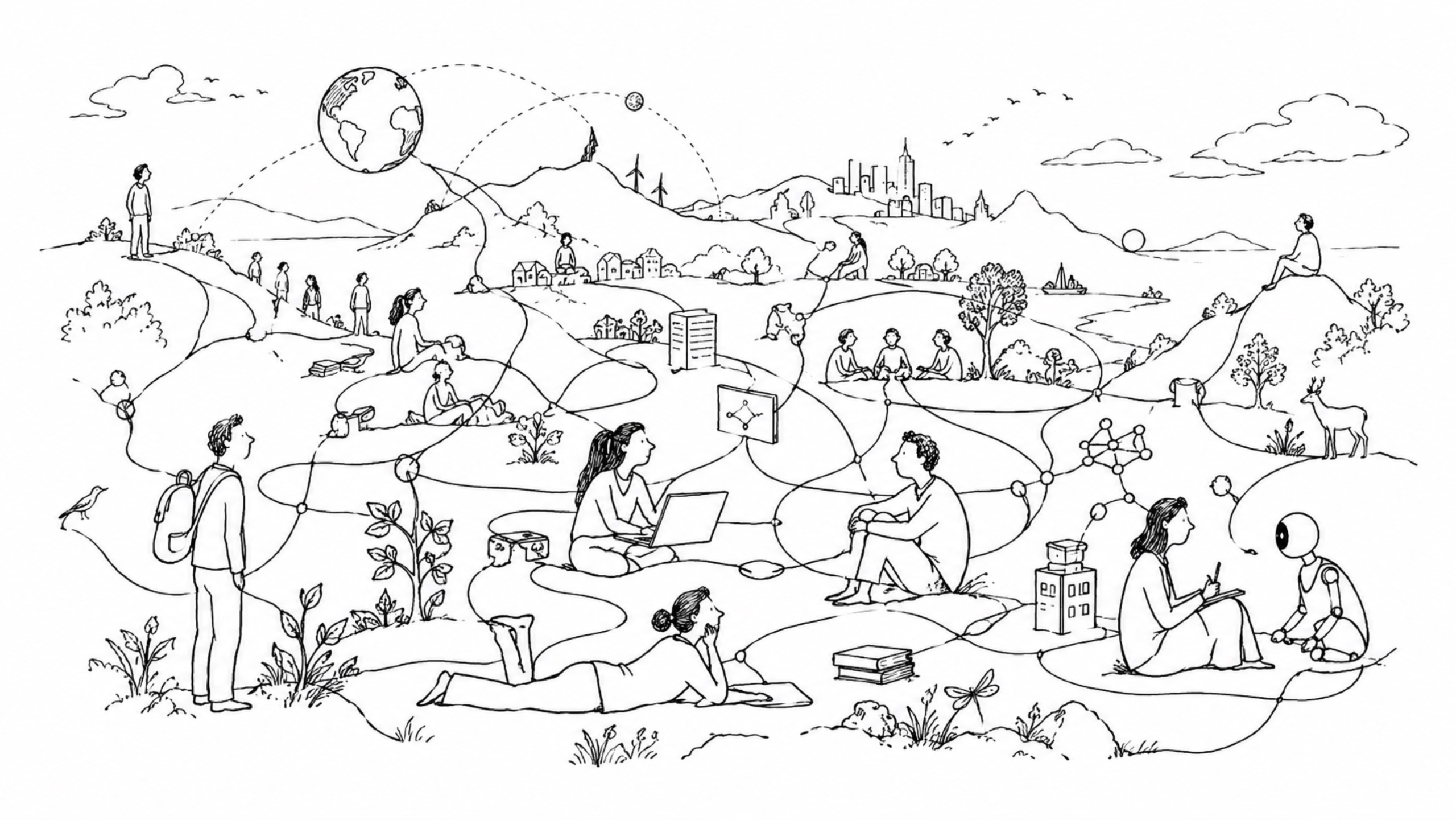
 

Just a metatool? Some thoughts why generative AIs are not tools

hammer holding an AI nailMany people brush generative AI aside as being just a tool. ChatGPT describes itself as such (I asked). I think it’s more complicated than that, and this post is going to be an attempt to explain why. I’m not sure about much of what follows and welcome any thoughts you may have on whether this resonates with you and, if not, why not.

What makes something a tool

I think that to call something a tool is shorthand for it having all of the following 5 attributes:

  1. It is an object (physical, digital, cognitive, procedural, organizational, structural, conceptual, spiritual, etc. – i.e. the thing we normally identify as the tool),
  2. used with/designed for a purpose, that
  3. can extend the capabilities of an actor (an intelligent agent, typically human), who
  4. may perform an organized action or series of actions with it, that
  5. cause changes to a subject other than the tool itself (such as a foodstuff, or piece of paper, a mental state, or a configuration of bits),

More informally, less precisely, but perhaps more memorably:

A tool is something that an intelligent agent does something with in order to do something to something else

Let me unpack that a bit.

A pebble used as a knife sharpener is a tool, but one used to reinforce concrete is not. A pen used to write on paper is a tool, but the paper is not. The toolness in each case emerges from what the agent does and the fact that it is done to something, in order to achieve something (a sharp knife, some writing).

Any object we label as a tool can become part of another with different organization. A screwdriver can become an indefinitely large number of other tools  apart from one intended for driving screws. In fact, almost anything can become a tool with the right organization. The paper can be a tool if it is, say, used to scoop up dirt. And, when I say “paper”, remember that this is the label for the object I am calling a tool, but it is the purpose, what it does, how it is organized, and the subject it acts upon that makes it so.

It is not always easy to identify the “something else” that a tool affects. A saw used to cut wood is an archetypal tool, but a saw played with a bow to make music is, I think, not. Perhaps the bow is a tool, and maybe we could think of the saw as a tool acting on air molecules, but I think we tend to perceive it as the thing that is acted upon rather than the thing we do something with.

Toolness is intransitive: a computer may be a tool for running programs, and a program running on it may be a tool that fixes a corrupt disk, but a computer is not a tool for fixing a corrupt disk.

A great many tools are also a technologies in their own right. The intention and technique of the tool maker combines with that of the tool user, so the tool user may achieve more (or more reliably, faster, more consistently, etc) than would be possible without both. A fountain pen adds more to the writing assembly than a quill, for instance, so demanding less of the writer. Many tools are partnerships of this nature, allowing the cognition of more than one person to be shared. This is the ratchet that makes humans smart.

Often, the organization performed by the maker of a technology entirely replaces that of the tool user. A dish sponge is a tool, but a dishwasher is not: it is an appliance. Some skill is needed to load it but the dishwashing itself – the purpose for which it is designed – is entirely managed by the machine.

The case is less clear for an appliance like, say, a vacuum cleaner. I think this is because there are two aspects to the device: the mechanism that autonomously sucks dirt is what makes it an appliance, but the hose (or whatever) used to select the dirt to be removed is a tool. This is reflected in common usage, inasmuch as a vacuum cleaner is normally sold with what are universally described as tools (i.e. the things that a person actively manipulates). The same distinction is still there in a handheld machine, too – in fact, many come with additional tools – though I would be much more comfortable describing the whole device as a tool, because that’s what is manipulated to suck up the dirt. Many power tools fit in this category: they do some of the work autonomously but they are still things people do something with in order to do something to something else.

Humans can occasionally be accurately described as tools: the movie Swiss Army Man, for instance, features Daniel Radcliffe as a corpse that turns out to have many highly inventive uses. For real live humans, though, the case is less clear.  Employees in scripted call centres, or teachers following scripted lesson plans are more like appliances than tools: having been “programmed”, they run autonomously, so the scripts may be tools but the people are not. Most other ways of using other people are even less tool-like. If I ask you to pick up some shopping for me, say, then my techniques of persuasion may be tools, but you are the one organizing phenomena to shop, which is the purpose in question.

The case is similar for sheepdogs (though they are not themselves tool users), that I would be reluctant to label as tools, though skills are clearly needed to make them do our bidding and they do serve tool-like purposes as part of the technology of shepherding. The tools, though, are the commands, methods of training, treats, and so on, not the animals themselves.

Why generative AIs are not tools

For the same reasons of transitivity that dishwashers, people, and sheepdogs are not normally tools, neither are generative AIs. Prompts and other means of getting AIs to do our bidding are tools but generative AIs themselves work autonomously.  This comes with the proviso that almost anything can be repurposed so there is nothing that is not at least latently a tool but, at least in their most familiar guises, generative AIs tend not to be.

Unlike conventional appliances, but more like sheepdogs, the work generative AIs perform is neither designed by humans nor scrutable to us. Unlike sheepdogs, but more like humans, generative AIs are tool users, too: not just (or not so much) words, but libraries, programming languages, web crawlers, filters, and so on. Unlike humans, though, generative AIs act with their users’ intentions, not their own, expressed through the tools with which we interact with them.  They are a bit like partial brains, perhaps, remarkably capable but not aware of nor able to use that capability autonomously.

It’s not just chatbots. Many recommender systems and search engines (increasingly incorporating deep learning), also sit uncomfortably in the category of tools, though they are often presented as such. Amazon’s search, say, is not (primarily) designed to help you find what you are looking for but to push things at you that Amazon would like you to buy, which is why you must troll through countless not-quite-right things despite it being perfectly capable of exactly matching your needs. If it is anyone’s tool, it is Amazon’s, not ours. The same for a Google search: the tools are your search terms, not Google Search, and it is acting quite independently in performing the search and returning results that are likely more beneficial to Google than to you. This is not true of all search systems. If I search for a file on my own computer then, if it fails to provide what I am looking for, it is a sign that the tool (and I think it is a tool because the results should be entirely determinate) is malfunctioning. Back in those far off days when Amazon wanted you to find what you wanted or Google tried to provide the closest match to your search term, if not tools then we could at least think of them as appliances designed to be controlled by us.

I think we need a different term for these things. I like “metatool” because it is catchy and fairly accurate. A metatool is something that uses tools to do our bidding, not a tool in its own right.  It is something that we use tools to act upon that is itself a tool user. I think this is better than a lot of other metaphors we might use: slave, assistant (Claude describes itself, incidentally, not as ‘merely’ a tool, but as an intelligent assistant), partner, co-worker, contractor, etc all suggest more agency and intention than generative AIs actually possess, but appliance, machine, device, etc fail to capture the creativity, tailoring, and unpredictability of the results.

Why it matters

The big problem with treating generative AIs as tools is that it overplays our own agency and underplays the creative agency of the AI. It encourages us to think of them, like actual tools, as, cognitive prostheses, ways of augmenting and amplifying but still using and preserving human cognitive capabilities, when what we are actually doing is using theirs. It also encourages us to think the results will be more deterministic than they actually are. This is not to negate the skill needed to use prompts effectively, nor to underplay the need to understand what the prompt is acting upon. Just as the shepherd needs to know the sheepdog, the genAI user has to know how their tools will affect the medium.

Like all technologies, these strange partial brains effectively enlarge our own. All other technologies, though, embed or embody other humans’ thinking and/or our own. Though largely consisting of the compressed expressed thoughts of millions of people, AI’s thoughts are not human thoughts: even using the most transparent of them, we have very little access to the mechanisms behind their probablistic deliberations. And yet, nor are they independent thinking agents. Like any technology we might think of them as cognitive extensions but, if they are, then it is as though we have undergone an extreme form of corpus callosotomy, or we are experiencing something like Jaynes’s bicameral mind. Generative AIs are their own thing: an embodiment of collective intelligence as well as contributors to our own, wrapped up in a whole bunch of intentional programming and training that imbues them, in part, with (and I find this very troubling) the values of their creators and in part with the sum output of a great many humans who created the data on which they are trained.

I don’t know whether this is, ultimately, a bad thing. Perhaps it is another stage in our evolution that will make us more fit to deal with the complex world and new problems in it that we collectively continue to create. Perhaps it will make us less smart, or more the same, or less creative. Perhaps it will have the opposite effects. Most likely it will involve a bit of all of that. I think it is important that we recognize it as something new in the world, though, and not just another tool.

Venturing into the Unknown: Critical Insights into Grey Areas and Pioneering Future Directions in Educational Generative AI Research | TechTrends

The latest paper I can proudly add to my list of publications,  Venturing into the Unknown: Critical Insights into Grey Areas and Pioneering Future Directions in Educational Generative AI Research has been published in the (unfortunately) closed journal TechTrends. Here’s a direct link to the paper that should hopefully bypass the paywall, if it has not been used too often.

I’m 16th of 47 coauthors, led by the truly wonderful Junhong Xiao, who is the primary orchestrator and mastermind behind it. This is a companion piece to our Manifesto for Teaching and Learning in a Time of Generative AI and it starts where the other paper left off, delving further into what we don’t know (or at least do not agree that we know) about and (taking up most of the paper) what we might do about that lack of knowledge. I think this presents a pretty useful and wide-ranging research agenda for anyone with an interest in AI and education.

Methodologically, it emerged through a collaborative writing process between a very multinational group of international researchers in open, digital, and online learning. It’s not a random sample of people who happen to know one another: the huge group represents a rich mix of (extremely) well-established and (excellent) emerging researchers from a broad set of cultural backgrounds, covering a wide range of research interests in the field. Junhong does a great job of extracting the themes and organizing all of that into a coherent narrative.

In many ways I like this paper more than its companion piece. I think this is because, though its findings are – as the title implies – less well-defined than the first, I am more closely aligned with the underlying assumptions, attitudes and values that underpin the analysis. It grapples more firmly with the wicked problems and it goes deeper into the broader, situated, human nature of the systems in which generative AI is necessarily intertwingled, skimming over the more simplistic conversations about cheating, reliability, and so on to get at some meatier but more fundamental issues that, ultimately, relate to how and why we do this education thing in the first place.

Abstract

Advocates of AI in Education (AIEd) assert that the current generation of technologies, collectively dubbed artificial intelligence, including generative artificial intelligence (GenAI), promise results that can transform our conceptions of what education looks like. Therefore, it is imperative to investigate how educators perceive GenAI and its potential use and future impact on education. Adopting the methodology of collective writing as an inquiry, this study reports on the participating educators’ perceived grey areas (i.e. issues that are unclear and/or controversial) and recommendations on future research. The grey areas reported cover decision-making on the use of GenAI, AI ethics, appropriate levels of use of GenAI in education, impact on learning and teaching, policy, data, GenAI outputs, humans in the loop and public–private partnerships. Recommended directions for future research include learning and teaching, ethical and legal implications, ownership/authorship, funding, technology, research support, AI metaphor and types of research. Each theme or subtheme is presented in the form of a statement, followed by a justification. These findings serve as a call to action to encourage a continuing debate around GenAI and to engage more educators in research. The paper concludes that unless we can ask the right questions now, we may find that, in the pursuit of greater efficiency, we have lost the very essence of what it means to educate and learn.

Reference

Xiao, J., Bozkurt, A., Nichols, M., Pazurek, A., Stracke, C. M., Bai, J. Y. H., Farrow, R., Mulligan, D., Nerantzi, C., Sharma, R. C., Singh, L., Frumin, I., Swindell, A., Honeychurch, S., Bond, M., Dron, J., Moore, S., Leng, J., van Tryon, P. J. S., … Themeli, C. (2025). Venturing into the Unknown: Critical Insights into Grey Areas and Pioneering Future Directions in Educational Generative AI Research. TechTrends. https://doi.org/10.1007/s11528-025-01060-6

The collective ochlotecture of large language models: slides from my talk at CI.edu, 2024

Here are my slides from the 1st International Symposium on Educating for Collective Intelligence, last week, here is my paper on which it was based, and here is the video of the talk itself:

You can find this and videos of the rest of the stunning line-up of speakers at https://www.youtube.com/playlist?list=PLcS9QDvS_uS6kGxefLFr3kFToVIvIpisn It was an incredibly engaging and energizing event: the chat alone was a masterclass in collective intelligence that was difficult to follow at times but that was filled with rich insights and enlightening debates. The symposium site, that has all this and more, is at https://cic.uts.edu.au/events/collective-intelligence-edu-2024/

Collective intelligence, represented in the style of 1950s children's books.With just 10 minutes to make the case and 10 minutes for discussion, none of us were able to go into much depth in our talks. In mine I introduced the term “ochlotecture”, from the Classical Greek ὄχλος (ochlos), meaning  “multitude” and τέκτων (tektōn) meaning “builder” to describe the structures and processes that define the stuff that gives shape and form to collections of people and their interactions. I think we need such a term because there are virtually infinite ways that such things can be configured, and the configuration makes all the difference. We blithely talk of things like groups, teams, clubs, companies, squads, and, of course, collectives, assuming that others will share an understanding of what we mean when, of course, they don’t. There were at least half a dozen quite distinct uses of the term “collective intelligence” in this symposium alone. I’m still working on a big paper on this subject that goes into some depth on the various dimensions of interest as they pertain to a wide range of social organizations but, for this talk, I was only concerned with the ochlotecture of collectives (a term I much prefer to “collective intelligence” because intelligence is such a slippery word, and collective stupidity is at least as common). From an ochlotectural perspective, these consist of a means of collecting crowd-generated information, processing it, and presenting the processed results back to the crowd. Human collective ochlotectures often contain other elements – group norms, structural hierarchies, schedules, digital media, etc – but I think those are the defining features. If I am right then large language models (LLMs) are collectives, too, because that is exactly what they do. Unlike most other collectives, though (a collectively driven search engine like Google Search being one of a few partial exceptions) the processing is unique to each run of the cycle, generated via a prompt or similar input. This is what makes them so powerful, and it is what makes their mimicry of human soft technique so compelling.

I did eventually get around to the theme of the conference. I spent a while discussing why LLMs are troubling – the fact that we learn values, attitudes, ways of being, etc from interacting with them; the risks to our collective intelligence caused by them being part of the crowd, not just aggregators and processors of its outputs; and the potential loss of the soft, creative skills they can replace – and ended with what that implies for how we should act as educators: essentially, to focus on the tacit curriculum that has, till now, always come from free; to focus on community because learning to be human from and with other humans is what it is all about; and to decouple credentials so as to reduce the focus on measurable outcomes that AIs can both teach and achieve better than an average human. I also suggested a couple of principles for dealing with generative AIs: to treat them as partners rather than tools, and to use them to support and nurture human connections, as ochlotects as much as parts of the ochlotecture.

I had a point to make in a short time, so the way I presented it was a bit of a caricature of my more considered views on the matter. If you want a more balanced view, and to get a bit more of the theoretical backdrop to all this, Tim Fawns’s talk (that follows mine and that will probably play automatically after it if you play the video above) says it all, with far greater erudition and lucidity, and adds a few very valuable layers of its own. Though he uses different words and explains it far better than I, his notion of entanglement closely echoes my own ideas about the nature of technology and the roles it plays in our cognition. I like the word “intertwingled” more than “entangled” because of its more positive associations and the sense of emergent order it conveys, but we mean substantially the same thing: in fact, the example he gave of a car is one that I have frequently used myself, in exactly the same way.